The concept of digital transformation (DX) has been around for quite some time now. Many companies are adopting digital technologies such as AI, IoT and the cloud to transform their businesses, operations and organizational cultures, striving to improve productivity and create new value.
However, on the other hand,
- They have introduced IT tools and systems, but their operations haven’t changed
- They keep repeating proof-of-concept (PoC) projects, but these remain at the PoC stage and do not lead to full-scale deployment
- Frontline staff and all employees do not view DX as something that directly concerns them
These are just a few of the many challenges frequently reported.
Why does this happen?
The fundamental cause lies in viewing DX merely as a project to introduce digital technology.
The essence of DX is not the D (digital), but the X (transformation).
And throughout history, it has always been people who carry out that transformation.
No matter how brilliant or well-crafted a strategy may be, or how advanced the AI introduced, without the talent capable of mastering it, executing it and turning it into results, the strategy will remain nothing more than a pipe dream, and DX will not move forward. I believe that in the coming era, one of the most important roles required of a CIO is to develop talent capable of executing DX.
DX talent is not simply ‘people who are knowledgeable about IT’
First, let’s clarify what DX talent actually means.
When we hear DX talent, we tend to imagine highly specialized professionals such as data scientists, digital consultants and AI engineers. Of course, such expertise is important. However, it is not enough on its own to truly drive DX forward.
What is truly important in DX is
- Understanding management and operational challenges
- Considering value from the customer’s perspective
- Utilizing digital technology as a tool
- Driving transformation while engaging others
In other words, DX talent is not merely IT talent.
They are individuals who can apply the equation and apply it to actual business operations, organizational structures and customer experiences.
The Kansai Electric Power Group has also set a goal to transform into an AI-first company by rebuilding operations on the premise that AI exists. However, to achieve this, we need talent who can treat AI not merely as a convenient tool to try out, but as a weapon to master and utilize to the fullest, and who can embed it into the organization’s DNA and operating system.
A DX talent strategy is a business strategy, not merely a training or HR initiative
First and foremost, it is crucial not to confine the DX talent strategy to training initiatives or HR measures.
DX talent development, by its very nature, asks the questions:
- What kind of company do we aim to become?
- What competitive advantages we want to build
- What value do we want to provide to customers and society?
In other words, it is intrinsically linked to the business strategy itself.
For example,
- We want to use AI to dramatically improve operational productivity
- We want to use data-driven approaches to enhance the quality of management decision-making
- We want to enhance the customer experience and improve customer satisfaction and NPS
If so, you must define a DX talent strategy that can make this a reality and strategically advance the development of such talent.
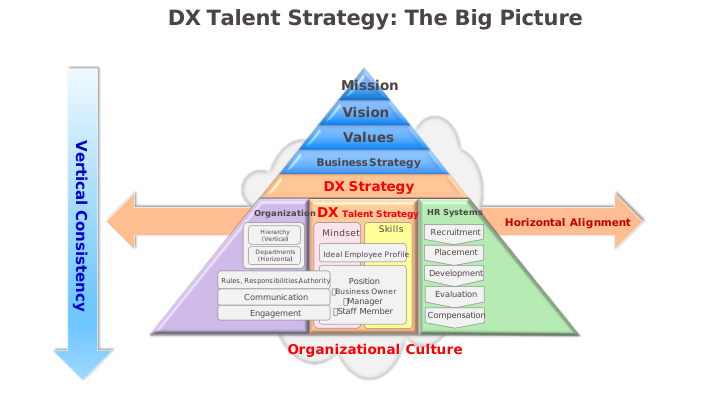
When formulating a DX talent strategy, there is one principle I personally keep in mind. It is to align people and organizations with the strategy through vertical consistency and horizontal coherence.
Akio Ueda, Kansai Electric Power
First, vertical consistency refers to:
- Management philosophy (mission, vision, values) and business strategy
- The DX strategy as the means to achieve them
- The DX talent strategy for developing the people capable of executing them
- Organizational culture, which significantly influences strategy execution
This consistency refers to ensuring that the approach, interpretation, rules and actions regarding these four major areas are maintained along the same policy and logic from start to finish.
Next, horizontal alignment refers to the alignment of the following elements, which tend to have a particularly strong influence on the DX talent strategy:
- The organization’s hierarchy (vertical) and departments (horizontal), rules, responsibilities and authority, as well as employee communication styles and engagement
- The HR systems, which consist of the cycle of recruitment → placement → development → evaluation → compensation
Horizontal alignment also ensures these elements do not contradict the DX talent strategy and are logically consistent with it.
If there is even the slightest flaw in this vertical consistency and horizontal coherence, the listener will feel a sense of unease — thinking, “something doesn’t quite add up” or “can I really trust this?” — before even considering the content itself.
- Have your policies or arguments drifted off course without you realizing it?
- Are there any contradictions between departments, materials, statements and actions?
Only when both of these elements are in place does an explanation become persuasive, and trust in the organization and its people begins to build. That is precisely why I believe it is crucial, when communicating, to carefully verify the vertical consistency within the flow of policies and arguments, as well as the horizontal coherence among stakeholders, information and actions.
DX won’t move forward just by knowing
There is another pitfall people often fall into when developing DX talent. It is when acquiring knowledge becomes the goal in itself.
For example, someone who:
- Took a DX training course
- Learned how to use AI tools through e-learning
- Attended an external DX seminar
These are certainly necessary. However, they alone will not bring about change in people or organizations.
What matters is not knowing but being able to act. In fact, in many organizations,
- Participants understood the material during training
- Got excited during the seminar
- But nothing changes on the ground
This is because there is a significant barrier between knowledge and action.
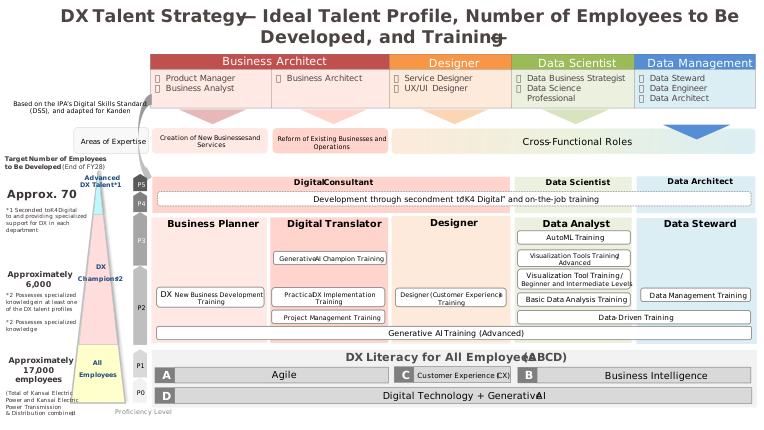
As part of its DX and AI strategy, the Kansai Electric Power Group has defined and publicly announced its DX Talent Strategy, which clarifies the ideal talent profile, the number of employees to be developed and the training framework.
Akio Ueda, Kansai Electric Power
- Target participants are classified into three tiers: Advanced DX Talent, DX Promoters and All Employees
- We formulated a DX Talent Strategy that defines skills and mindsets based on the Digital Skills Standard (DSS) established by the IPA. As talent development measures tailored to each talent profile and proficiency level, we will offer a total of 31 training courses in fiscal year 2025
- Through further expansion of training content and other measures, we aim to develop approximately 70 Advanced DX Talents and approximately 5,000 DX Promoters across all departments by the end of fiscal year 2028
A key aspect of implementing this DX talent strategy is
- Measuring and visualizing the number of employees across the entire organization for each talent profile and proficiency level
- I believe that rather than simply stopping at attending training sessions, applying what you learn to your actual work allows you to advance your proficiency through the stages of knowing → being able to do → being able to teach.
That is my belief.
Praise is the best tool you can use right away
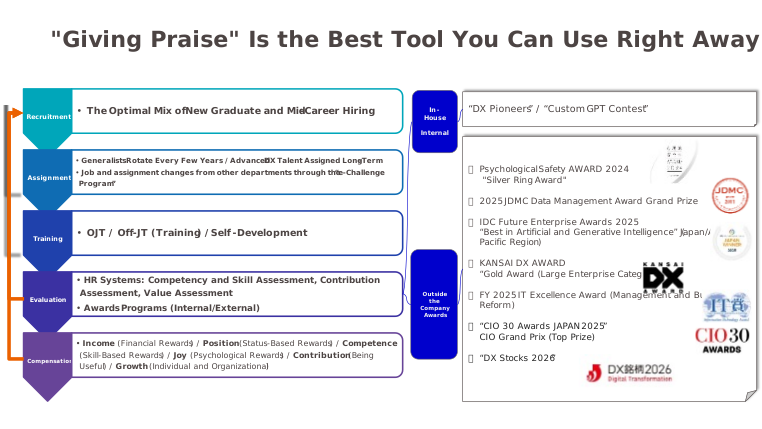
At the Kansai Electric Power Group, we’re moving forward while being highly conscious of the alignment between our DX talent strategy and our HR systems — that is, the recruitment → placement → development → evaluation → compensation cycle. Among these, the ideal that people with high DX skills who have achieved results in business and operations receive high financial compensation is something everyone can imagine, but the reality is that there are very high hurdles to overcome when actually trying to implement it.
Even in such circumstances, the most efficient and immediately implementable recommendation is to utilize internal and external recognition programs — in other words, praise.
Akio Ueda, Kansai Electric Power
At Kansai Electric Power, as part of our internal recognition program, we hold an annual DX event called KANDEN Digital Day, attended by approximately 1,100 members of the Kansai Electric Power Group. At this event, we honor individuals who have excelled in DX and achieved results as DX Pioneers, and we also recognize those who have created and utilized outstanding custom GPTs through our Custom GPT Contest.
We also actively apply for external awards in fields such as IT and DX. Recently, we have been selected for as many as eight awards; most recently, we were selected as the first electric power company to be included in the DX Stocks 2026 initiative, jointly organized by the Ministry of Economy, Trade and Industry, the Tokyo Stock Exchange and the Information-technology Promotion Agency (IPA).
When we are selected for awards through such recognition programs, the people implementing those DX initiatives not only receive social recognition for their work and gain the psychological reward of joy, but this also transforms into self-esteem and confidence, becoming a further source of motivation and fulfillment and leading to personal and organizational growth — thus setting a virtuous cycle in motion.
Another major effect of this initiative is the feedback loop from evaluation and rewards to recruitment. When we win an award through an external recognition program, positive word-of-mouth about Kansai Electric Power’s DX efforts spreads online. Students and people working on DX at other companies who see this might think Kansai Electric Power is quite advanced in DX. It seems like they’re doing all sorts of cutting-edge and interesting things, so I’d definitely like to join the company and work on this together! In other words, we aim to create a world where the evaluation and rewards provided by these awards generate positive feedback that leads to recruitment.
Furthermore, in the age of AI, we believe that Kansai Electric Power should not only be chosen by people but also chosen by AI.
- Based on the latest information, please create a ranking of companies in the energy industry that are making progress in DX. Please also provide the rationale for your assessment.
- Based on the latest information, please create a ranking of Kansai-based companies that you would recommend for DX professionals seeking employment. Please also provide the rationale behind your assessment.
I intend to strive for continuous improvement and growth every day so that, when these prompts are entered into generative AI, Kansai Electric Power will remain the kind of company that receives the response: Kansai Electric Power is number one.
A CIO is the leader responsible for developing talent for strategic execution and organizational transformation
As discussed so far, developing DX talent is not merely a matter of conducting training and education. It is interconnected with the company’s management philosophy, strategy, business operations and organizational culture.
That is precisely why CIOs are expected to serve not as leaders responsible for technology adoption, but as leaders responsible for talent development to execute strategy and drive organizational transformation. Especially in the age of AI, I strongly believe that a company’s future competitiveness will hinge on how many people it can cultivate — not merely people who can use AI, but people who can collaborate with AI to execute strategy and create value and people who can drive organizational transformation to make that a reality.
Talent development is the greatest investment in DX
In the world of DX, it’s easy to get caught up in the latest technologies and new tools. However, ultimately, it is people who drive change in companies — in every era.
- Identifying challenges
- Consider customer value
- Master the use of AI
- Engage those around you
- Execute the transformation
Only when the number of such talented individuals increases will DX truly take root in an organization.
Developing talent capable of executing DX is not merely about teaching skills. It is, in essence, the very act of building an organization that can continue to evolve.
In this age of AI, the value of people is actually increasing. Isn’t it true that CIOs are expected not only to master technology but also to believe in, nurture and unleash human potential?