Organizations continue to invest heavily in the cloud, with IT leaders reporting that 26% of their IT budget will be allocated to cloud computing within the next year, according to the 2026 Foundry Cloud Computing Study.
The survey also found that 74% of IT leaders have accelerated cloud migrations in the past 12 months compared to 70% in 2025 and 63% in 2024. Three in four (73%) also said cloud capabilities have helped their organizations achieve “increased and sustainable revenue over the past 12 months.” Overwhelmingly, 80% of respondents from North America and APAC noted that their cloud strategies have helped accelerate the adoption of AI, while that number drops to 68% for the EMEA region.
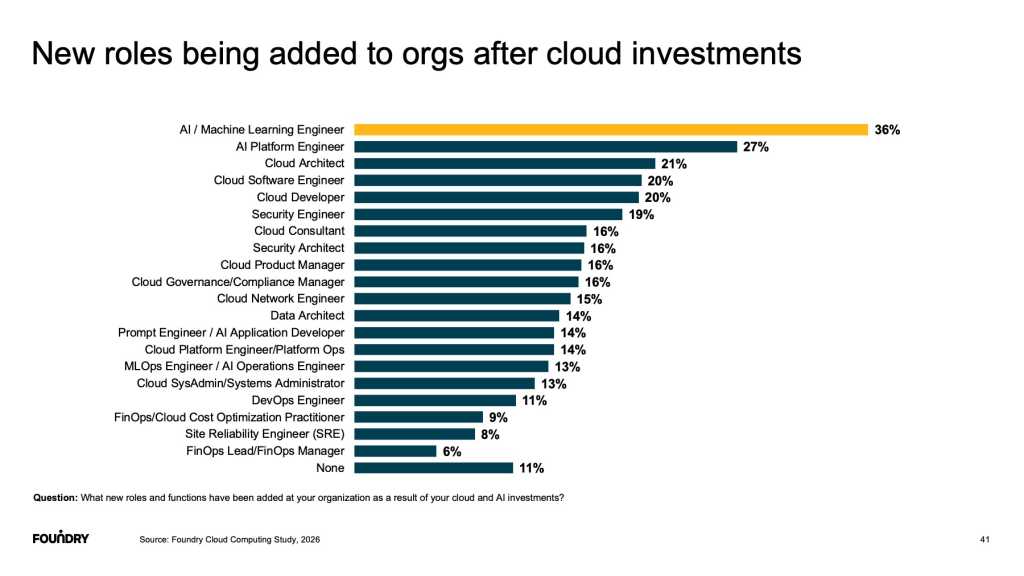
This growth in cloud adoption, along with accelerated interest in AI, has sparked an increased demand for certain cloud roles. Here are the roles companies are most likely to have added to support their cloud investments, according to Foundry’s research.
And for those looking to break into this lucrative IT pathway, see “Where to begin a cloud career” and “18 best entry-level IT certifications to launch your career,” which includes several good cloud-related credentials to get started with.
Foundry
AI/ML engineer
The role of AI/ML engineer is in high demand as organization expand their AI strategies. These professionals design and implement AI and machine learning systems, overseeing them in operation to identify opportunities for improvement, ways to better automate processes, and how to better inform decision-making across the organization.
Skills: Skills for this role include programming, knowledge of machine learning, data science, data engineering, and experience building AI systems using APIs. See also: “The hidden skills behind the AI engineer.”
Role growth: 36% of companies have added AI/machine learning engineers as part of their cloud investments, according to Foundry’s survey.
AI platform engineer
An AI platform engineer is responsible for building and running the internal systems that businesses use to build and scale AI tools and initiatives. As organizations increasingly adopt AI internally, they’re hiring professionals to help navigate the daily operations of internal developer platforms (IDPs) that use AI to boost productivity and drive automation.
Skills: Skills for this role include understanding of cloud infrastructure, programming languages, and orchestration and container technology, including Kubernetes and Docker.
Role growth: 27% of companies have added AI platform engineers as part of their cloud investments.
Cloud architect
As cloud computing grows increasingly complex, cloud architects have become vital for navigating the nuances of implementing and maintaining cloud environments. These IT pros can help organizations avoid cloud security risks, while also ensuring a smooth transition to the cloud. With 65% of IT leaders choosing cloud-based services by default when upgrading technology, cloud architects will only become more important for enterprise success. For those interested in this role, see “IT career roadmap: Cloud architect.”
Skills: Skills for this role include knowledge of application architecture, automation, ITSM, governance, security, and leadership.
Role growth: 21% of companies have added cloud architect roles as part of their cloud investments.
Cloud software engineer
Cloud software engineers are tasked with developing and maintaining software applications that run on cloud platforms, ensuring they are built to be scalable, reliable, and agile. Companies that have migrated to the cloud often need IT pros who can build company-specific services and applications to make the most of the cloud environment. For more on this career path, see “IT career roadmap: Cloud engineer.”
Skills: Relevant skills for a cloud software engineer include Python, Java, C#, JavaScript, microservices architecture, serverless computing, APIs and SKDs, DevOps, cybersecurity, and knowledge of the agile methodology.
Role growth: 20% of companies have added cloud software engineer roles as part of their cloud investments.
Cloud developer
Cloud developer is a vital role for developing and deploying software in cloud environments. These IT pros are tasked with designing, creating, and deploying applications designed to run on cloud platforms, with a focus on building scalable, reliable, and cost-effective solutions to meet business needs.
Skills: Relevant skills for a cloud developer include programming languages such as Java, C#, and Python as well as knowledge of popular cloud platforms, microservices architecture, database storage, agile methodology, APIs and SKDs, and containers and orchestration.
Role growth: 20% of companies have added cloud developer roles as part of their cloud investments.
Security engineer
Security engineers are tasked with overseeing the security of an organization’s systems, networks, and data, to make sure they’re protected from cybersecurity threats. For organizations investing in the cloud, security engineers can help ensure services, applications, and data running on cloud platforms are secure and compliant with any government regulations.
Skills: Network security, IAM, encryption, vulnerability management, security architecture, cloud security, automation, and infrastructure design and optimization.
Role growth: 19% of companies have added security engineer roles as part of their cloud investments.
Cloud consultant
With the rapid adoption and move to the cloud, organizations look for professionals who can leverage cloud technologies to meet business needs, grow the business, and improve efficiency. Cloud consultants are cloud experts who stay on top of the latest innovations in cloud technology to better advise business leaders.
Skills: Knowledge of architecture and solution design, DevOps, automation, project management, cloud security, compliance, cloud migration, and knowledge of popular cloud platforms.
Role growth: 16% of companies have added cloud consultants as part of their cloud investments.
Security architect
Security architects are responsible for building, designing, and implementing security solutions in the organization to keep IT infrastructure secure. For security architects working in a cloud environment, the focus is on designing and implementing security solutions that protect cloud-based infrastructure, data, and applications.
Skills: Security architecture design, network security, security compliance and governance, incident response and forensics, data encryption, IAM, automation, and DevSecOps.
Role growth: 16% of businesses have added security architect roles as part of their cloud investments.
Cloud product manager
With cloud adoption often comes an increase in in-house development of cloud-based services. A cloud product manager can help cloud teams develop effective solutions aimed at fulfilling business objectives. They’re also tasked with using their deep understanding of product management within the cloud environment to work closely with key stakeholders, identify and define requirements from users or customers, develop product roadmaps, and oversee the QA process to gain feedback on how to improve product offerings.
Skills: Product management, UX design, communication and collaboration, and a strong technical background.
Role growth: 16% of organizations have added cloud product manager roles as part of their cloud investments.
Cloud governance/compliance manager
Cloud governance and compliance managers help companies navigate the complexities of security, governance, international regulation, and internal policies. They identify potential risks, implement automated tools to oversee security and compliance, and help businesses maintain secure cloud operations.
Skills: A strong knowledge of regulatory policies such as GDPR, HIPAA, PCI DSS, and other international data protection laws. Additional skills include knowledge of tools such as CSPM, Azure, AWS, Microsoft Purview Compliance Manager, and other IT governance tools.
Role growth: 16% of businesses have added cloud governance and compliance manager roles as part of their cloud investments.
Cloud network engineer
Cloud network engineers are responsible for the design, implementation, and management of an organization’s cloud-based networks. These IT pros are tasked with overseeing network management, virtualization and virtual LAN, wide area networks, TCP/IP, HTTP, network security, and the integration of hybrid cloud and multicloud deployments.
Skills: Relevant skills for this role include knowledge of cloud platforms such as Azure, AWS, Google Cloud, along with networking fundamentals, virtualization, project management, security, automation and scripting, and collaboration.
Role growth: 15% of companies have added cloud network engineer roles as part of their cloud investments.
Data architect
A data architect’s focus is seeing that an organization’s data is structured so it can be easily accessed, secured, and efficiently stored, and that it meets business needs. Data has become a primary way for businesses to conduct analysis and assist with business decision-making, and most of that data is now stored in the cloud.
Skills: Data warehousing, scalability and performance optimization, automation and virtualization, data governance and cloud security, data migration, and knowledge of hybrid cloud solutions.
Role growth: 14% of businesses have added data architect roles as part of their cloud investments.
Prompt engineer/AI application developer
Prompt engineering and AI application development go hand in hand, and they’ve become vital skills for organizations that have embraced AI and plan to implement AI-focused services and into daily workflows. Prompt engineers are responsible for designing and refining the instructions and structural queries, while an AI application developer builds software system and user-interfaces for AI-ready software and services.
Skills: Skills for this role include programming languages, database management, API integration, and software engineering. See also: “How to get started with prompt engineering” and “Prompt engineering courses and certifications tech companies want.”
Role growth: 14% of companies have added prompt engineering and AI application developer roles as part of their cloud investments.
Cloud platform engineer/platform ops
Cloud platform engineers, who often work in platform operations, are responsible for building and maintaining cloud tools, automated systems, self-service portals, and other software that developers use to test code. In this capacity, they’re responsible for creating user-friendly platforms for other engineers in the company to build and test their own software for clients and customers.
Skills: Skills for this role include infrastructure as code (IaC), containerization and orchestration, scripting and coding, and Linux and networking.
Role growth: 14% of companies have added cloud platform engineering roles as part of their cloud investments.
MLOps engineer/AI operations engineer
The role of MLOps engineer or AIOps engineer has been developed to help close the gap between data science and IT operations. It’s a role that has emerged as the use of AI increases, as organizations need a point person who has expertise in IT operations and machine learning, and is comfortable collaborating with data scientists, developers, IT operations staff, and key stakeholders.
Skills: Skills for this role include programming, DevOps, cloud tools, containerization and orchestration, and knowledge of ML tools.
Role growth: 13% of companies have added MLOps engineers as part of their cloud investments.
Cloud sysadmin
Cloud systems administrators are charged with overseeing the general maintenance and management of cloud infrastructure. Whether that means implementing cloud-based policies, deploying patches and updates, or analyzing network performance, these IT pros are skilled at navigating virtualized environments. Cloud sysadmin is likely the most entry-level-friendly role on this list.
Skills: An understanding of implementation and integration, security, configuration, and knowledge of popular cloud software tools such as Azure, AWS, GCP, Exchange, and Office 365.
Role growth: 13% of companies have added cloud systems admin roles as part of their cloud investments.
DevOps engineer
DevOps focuses on blending IT operations with the development process to improve IT systems and act as a go-between in maintaining the flow of communication between coding and engineering teams. It’s a role that focuses on the deployment of automated applications, maintenance of IT and cloud infrastructure, and identifying potential risks and benefits of new software and systems.
Skills: Automation, Linux, QA testing, security, containerization, and knowledge of programming languages such as Java and Ruby.
Role growth: 11% of companies have added DevOps engineer roles as part of their cloud investments.
FinOps/cloud cost optimization practitioner
FinOps and cloud cost optimization practitioners combine knowledge of finance, technology, and businesses to help oversee the increasingly complex landscape of cloud investments. Cloud computing is integral to AI, so as more organizations invest in it, they’re also revisiting investments in cloud infrastructure. FinOps and cloud cost optimization practitioners can help guide organizations to make the right financial decisions around technology investments that’ll impact the business.
Skills: Knowledge of finance, business, and technology along with skills using tools and platforms including AWS, Azure, GCP, and cloud-native FinOps platforms.
Role growth: 9% of companies have added FinOps and cloud cost optimization practitioner roles as part of their cloud investments.
Site reliability engineer
For any organization implementing cloud strategies, there’s a significant focus on reliability and scalability, ensuring that data can be accessed from the cloud and on-demand as needed. Site reliability engineers (SREs) are responsible for overseeing automation of IT infrastructure, application monitoring, and system management. Cloud infrastructure requires frequent software updates, and services must be able to scale with the organization’s growth.
Skills: Change management, IT infrastructure management, emergency incident response, process improvement, and application monitoring.
Role growth: 8% of companies have added site reliability engineer roles as part of their cloud investments.
FinOps lead/FinOps manager
FinOps leads and FinOps managers are tasked with overseeing the intersection of engineering, finance, and business. As more organizations build cloud services and tools, they’re looking for FinOps professionals with technical knowledge to help bridge the gap between finance and tech, bringing better insights into ways to cut costs and stay on budget while implementing innovative technology.
Skills: FinOps leads and managers need a strong understanding of engineering, finance, and technology. Additional skills include knowledge of cloud platforms, basic coding skills, and data analytics.
Role growth: 6% of companies have added FinOps lead and FinOps manager roles as part of their cloud investments.
As cloud experience becomes more critical to organizations hosting AI-powered services, tools, and software, these cloud roles and skills will become increasingly in-demand. Now is an opportune time to seek out valuable cloud certifications and other relevant AI and ML certifications to boost your resume, and set yourself up for these emerging and established career paths.