In an August 2026 Gartner report, 40 percent of C-level executives say their organizations have “operationalized AI in some business processes,” yet only 13 percent say they have “achieved measurable results and are scaling AI across the organization.”
This disconnect reveals a frequent reality: AI may have been “hired”, but companies haven’t onboarded it effectively.
Research from HR analyst firm The Brandon Hall Group found that organizations with a strong people onboarding process improve new hire productivity by over 70 percent. Similarly, the first period of AI’s “employment” in a specific role largely determines how effectively it will perform and its perceived “growth potential”. But many tech executives are ignoring this crucial stage of the implementation process and are left with AI systems that cannot accomplish the complex tasks they’re assigned.
The most successful companies are those that treat AI like their newest hire instead of a long-tenured team member.
Onboarding AI means establishing the right context and connections
Establishing the AI’s persona, the context in which it operates, how it assesses itself and the people and systems to which it is connected are what define implementation success. Usefulness quickly diminishes when even one of these elements is left out of the onboarding process.
For example, we recently created an internal agent called ‘WorkRadar’ that surfaces missed tasks and answers questions like: “I’ve been on PTO, what’s the summary of what happened, what should I skim and what should I review in detail?” We gave this agent all potentially useful context by connecting it to Outlook, Microsoft Teams, Confluence, Asana, SharePoint, meeting notes and our human resource information system (HRIS) so it could determine the responsibilities of the person invoking it and infer topics of interest.
Much like a new employee, however, WorkRadar couldn’t derive the meaning behind this information without further guidance. When I first used the agent, it did not distinguish between strategic priorities and tactical work and also missed initiatives I sponsor across departments, outside the typical hierarchy. This version of WorkRadar did not know me enough to be useful and I was better off doing the work myself.
Instead of leaving WorkRadar to flail as-is, we further onboarded it by enabling users to provide the agent with a personalized description more detailed than it could infer through company documents alone. This included their own responsibilities, operating level, current priorities, key stakeholders for specific initiatives and communication style. For most workers, this is less than one page of short bullets and has made a significant difference. Now, many of our employees rely on WorkRadar like they would a stellar executive assistant, to ensure relevant outstanding to-do items don’t fall through the cracks and smooth their return from PTO.
Five principles that define AI success
WorkRadar’s improved onboarding illustrates the essential elements for priming AI. Managers should define each AI agent’s:
1. Role
Articulate the AI agent’s position and purpose in the organization; everything else derives from there. Tech implementers should determine if the AI agent should act as an employee avatar with the same access rights, a simpler approach, or act under its own identity, which is increasingly becoming best practice for governance, risk and compliance reasons.
Implementers should also decide whether the AI agent “sits” within their infrastructure or their vendor’s. Tech executives can determine this by assessing their companies’ business context, security posture and preference for hands-on involvement with agents. For companies like ours with more than one agentic stack, we have agents that sit in both places.
Finally, they should define which employee will be an agent’s supervisor, and the specific contexts in which AI stops for human review. It’s a huge mistake to have no ownership of a tech component and no human in the action or feedback loop to improve performance and address errors.
2. Remit
Articulate the outcomes this agent should achieve, then identify the systems it’ll need to access for information and to carry out its work. First, tech implementers must give AI read-write access to the systems it will modify via MCPs, tools, skills, APIs, just to name a few methods. This boundary-setting will determine AI’s “sphere of influence” (what we want it to access) and its “blast radius” (the systems we accept it may access and must protect from misuse).
To give AI guidance, employers must also give AI read access to job-relevant corporate directories and policies, so the agent knows how to navigate the organization and where to direct communication, as well as company strategy documents and project management trackers, so it can understand the “why” behind its work.
Control and security are a complex topic but, at a high level, implementers must also provide access to lists of governance and compliance limitations to define the boundaries by which agents must abide, plus tradecraft standards and procedures so the agent acts in accordance with industry and corporate best practices.
3. Personality
A huge amount of information could, and eventually must, go into an agent’s context. However, Agents have finite memory and focus, so, like people, they are easily overwhelmed with too much information. So, tech implementers must pick and choose which parts of the agent’s context are permanent and imbued in every task versus derived just-in-time by the agent.
This is the art and science of context engineering and it’s evolving rapidly. Elements that are omnipresent in all agent actions – persona, strategies, guardrails, etc. – constitute its system prompt. They’re written directly into the agent’s context by the user, system administrator and the agentic harness on a per-job role basis.
Meanwhile, employers should also define elements the agent derives in real-time. Frequently, the performance of an agent is determined in this probabilistic work, which is why delineating what’s permanent versus conjured in the moment can make or break an agent’s efficacy.
It’s a balancing act that’s costly on both ends: too much context, and the agent chases expensive side quests. Too little, and the agent burns resources discovering what it needs. Best practices ebb and flow, with foundation companies like Anthropic recently advocating for brevity, trusting increasingly stronger models to figure it out.
4. Performance review
Give AI the necessary tools and context to assess itself. Otherwise, the agent will be blind to its actual impact and require too much course-correction.
Ideally, employers give the agent a tool to capture and update new memories, including condensed feedback it has received or epiphanies it discovered itself. Ensuring an agent has this learnings memory bank will make it more performant over time since it does not have to repeatedly solve the same problems and can apply context across disparate tasks.
Finally, on a regular basis, the agent’s supervisor must evaluate its work by looking at actual outputs and giving the agent examples of its best and worst work so it can understand actions to continue and stop, respectively. These good and bad examples can be generalized and bundled, and supervisors can then test the AI against them to continually adjust for behavioral shifts. This may be the most neglected activity, yet the one most likely to turn a mediocre agent into a valuable colleague.
5. Teamwork
Lastly, permit AI to access specific communication surfaces like internal email and messenger platforms and interface with employees. For multi-agent orchestration, employers will have to open communication among agent “colleagues.” Each agent needs an awareness of collaborators and means to exchange messages and share files, all while continuing to involve human supervisors, who won’t inherit any errors that upstream agents might pass on to others. Grok and Hermes debuted bots with this capability in August 2026.
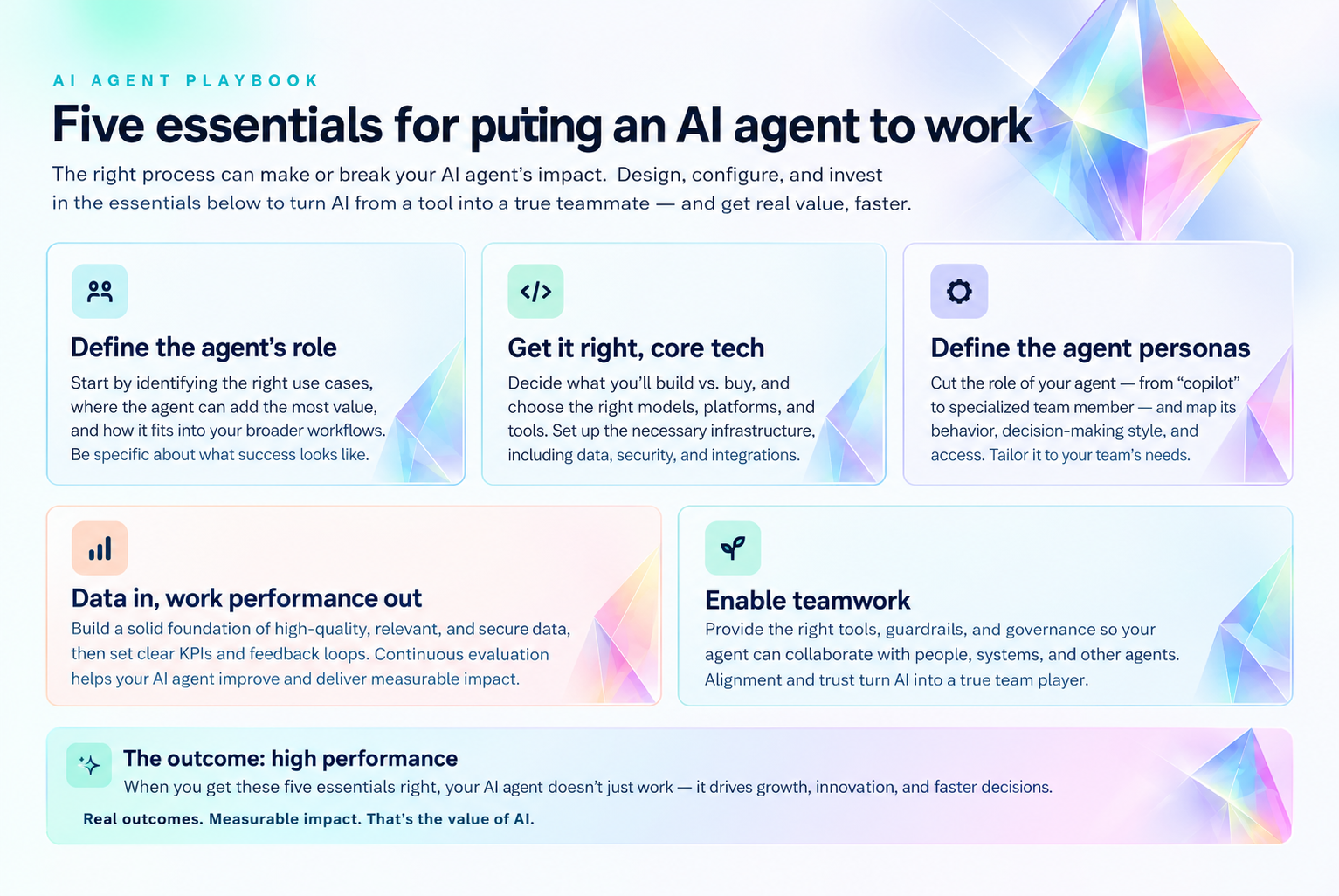
Defining AI’s role, context, persona, assessment frameworks and team connections is essential for successful implementation.
Pearl
Even with context, AI is still missing key working principles
Two additional considerations make AI that works like a veteran instead of a new employee.
First, tech implementers should realize AI’s memory is less focused than humans’. AI quickly becomes confused about core information versus extra details and can even lose parts of its “knowledge” because its effective context window is still only about 200K tokens. AI is also prone to “anchoring,” persistently latching onto a throwaway comment or early thought.
The implication for agentic AI users is to start fresh sessions much more frequently than might feel natural or to tap into continually evolving techniques to manage context, including compaction, truncation and summarization. Agentic platform makers have started to build this into their harnesses, but it’s still far from “set it and forget it”.
Second, and perhaps most frustrating of all, is AI’s myopic focus on its task without care or curiosity about the greater context surrounding it. This behavior causes it to implement solutions that miss important success criteria or violate critical constraints. In this sense, AI grants one’s wishes a bit like a genie, so be careful what you ask for and how you ask for it!
For example, left unprompted, coding agents are a bit too quick to jump to implementation. One architect solved this by creating a workflow that forces the agent to interview the developer first, sometimes asking upwards of 40 clarifying questions, to surface missing requirements and edge cases before writing a single line. Some agentic coding harnesses now perform developer interviews, but there’s still room for improvement.
These deeper techniques highlight that agents need more than a good initial onboarding; they need an iterative management approach, just like humans.
Many CIOs today are looking to use AI more for innovation and modernization than sheer productivity.
Assume AI already knows the job and you will be frustrated when it falls short. Treat it like a new hire and it will grow into one of your best.