There is a fundamental problem hiding behind today’s technology forecasts: the technology industry is projecting spending growth at rates that many of its customers cannot economically sustain.
Gartner’s July 2026 forecast calls for worldwide IT spending to increase 14.2% in 2026 to $6.37 trillion. Within that number, software is projected to rise 15.5%, Infrastructure-as-a-Service 29.3%, and data-center systems an extraordinary 62.5%. Gartner itself acknowledges that technology budgets are being strained by inflation, supply shortages, hardware and memory costs, and AI investment.
The AI projections are even more dramatic. Gartner’s September forecast puts 2026 worldwide AI spending at $2.7 trillion—up 49.5% in a single year. McKinsey has separately estimated that generative AI alone could drive $175–$250 billion of software spending by 2027, adding two to six percentage points to software-sector growth.
These are extraordinary numbers. But they expose a fundamental flaw in the way the technology market is being viewed: The forecasts measure what the technology industry expects to sell—not necessarily what its customers can afford to buy.
That distinction is critical.
The forecasts may describe what technology suppliers want to sell, what hyperscalers intend to build, and what analysts believe enterprises will demand. They do not demonstrate that the typical enterprise has the economic capacity to increase its technology budget at anything approaching those rates.
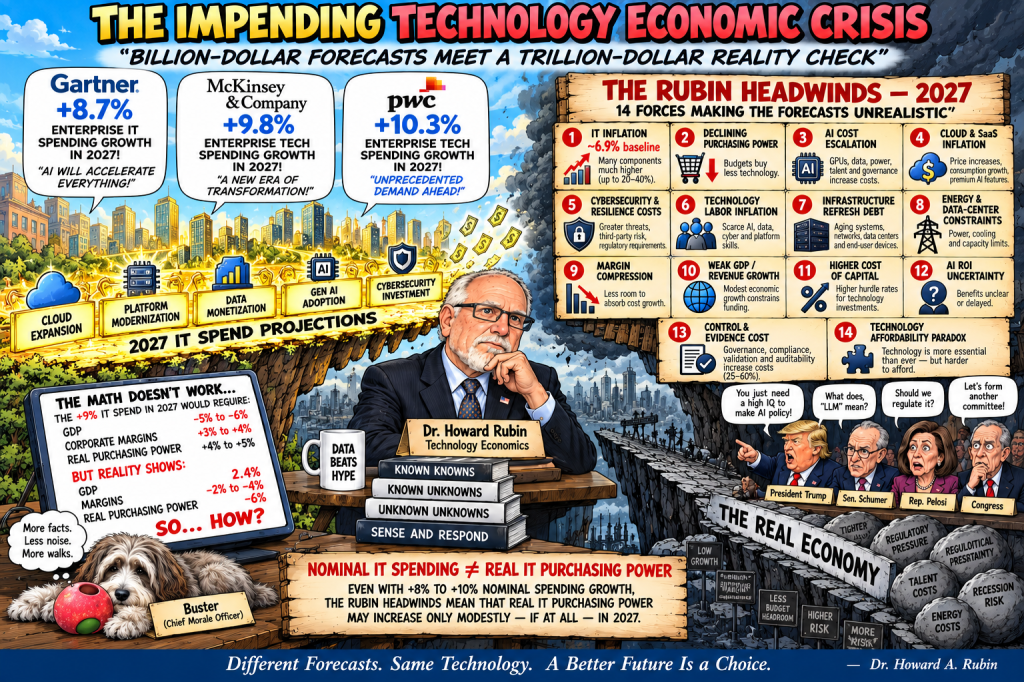
Dr. Howard A. Rubin
That is the collision illustrated in this cartoon. Most companies cannot indefinitely grow technology spending at 10%, 15%, 20%, 30% or even 50% when their revenues, operating margins and the economies in which they operate are growing at only a fraction of those rates.
And the affordability problem is actually worse than the headline spending forecasts suggest.
Enterprises simultaneously face the economic headwinds: IT inflation; AI premiums; rising compute, server and memory costs; cybersecurity; energy and datacenter requirements; technical debt; scarce technology talent; software and cloud price escalation; regulatory and control costs; and the continuing expense of maintaining yesterday’s technology while financing tomorrow’s.
The result is what I call the Technology Affordability Gap: Technology demand + technology inflation + AI investment + infrastructure requirements are growing faster than the economic capacity of many enterprises to pay for them.
This produces an extraordinary paradox. Every technology forecast can appear individually plausible from the supplier’s side while their collective implications become economically implausible from the customer’s side.
A hyperscaler can forecast enormous cloud growth. An AI company can forecast enormous AI adoption. A software company can forecast higher subscription revenue. A semiconductor company can forecast explosive demand for AI infrastructure. An analyst can add all of those expectations together.
But ultimately there is only one customer balance sheet paying the bills.
Something, therefore, has to give.
Enterprises will have to slow spending, eliminate legacy costs, consolidate vendors, renegotiate contracts, defer lower-value projects, substitute AI and automation for labor, radically improve technology productivity, and demand demonstrable economic returns from AI and other technology investments. Otherwise, technology spending will increasingly have to be financed by taking money away from other parts of the enterprise— or by sacrificing margins.
That is the impending Technology Economic Crisis.
It is not a crisis caused by a shortage of technology. It is potentially a crisis caused by more technology ambition, more technology supply and more technology spending expectations than the underlying economy can afford.
The question for 2027 and beyond, therefore, isn’t simply: “How much technology will companies want?”
It is: “How much technology can they actually afford?”