The billions flowing into chips, data centers, networks, and power systems have focused attention on the challenge of the AI buildout. But the more important question, according to Bain & Company’s Technology Report 2026, may be whether that buildout will produce economic value to justify it.
How much revenue does AI need to pay for itself?
Capital expenditures in the arms race among hyperscalers (Microsoft, Google, Amazon, Meta, and Oracle) could reach $780 billion in 2026. That’s almost five times the level of just three years earlier.
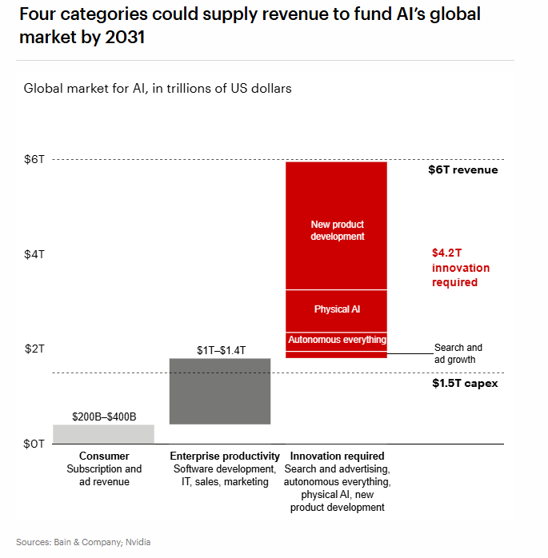
By 2031, spending on AI infrastructure could reach $1.5 trillion a year, including new data center infrastructure and compute capacity as well as ongoing upgrades to the installed base of GPUs, memory, and networking equipment.
If we assume that capital expenditures amount to about 25% of industry revenue (an ambitious but reasonable percentage based on trends among cloud providers), sustaining this level of investment would require an AI market approaching $6 trillion annually.
Where some of that revenue will come from is increasingly clear. Enterprise adoption could contribute $1 trillion to $1.4 trillion to providers alone as AI delivers meaningful productivity gains to enterprises across software development, sales, marketing, customer service, and IT operations. And consumer AI products, through subscriptions and advertising, could generate an estimated $200 billion to $400 billion by 2031. Together, those enterprise and consumer AI markets could total between $1.2 trillion and $1.8 trillion.
But that still leaves about $4.2 trillion of new revenue to reach the $6 trillion market that Bain estimates will be necessary to fund the buildout (see Figure 1). That revenue must come from new sources of economic value.
Figure 1
What does AI’s funding gap mean for non-tech companies?
The $4.2 trillion gap won’t be filled by the technology industry alone. Much of it is likely to come from value created across healthcare, manufacturing, mobility, energy, and other sectors.
Enterprise productivity is the first of the gains we’re seeing from AI deployment, but it won’t be nearly enough. The economics required to generate ROI from AI infrastructure are demanding trillions in new revenue, not just cost savings. The industry needs a wave of application innovation comparable with what mobile and cloud unlocked.
For CEOs outside the tech world, that wave is the part to watch. AI companies need new revenue and will have to build for new customers. The new products and capabilities that result could change how non-tech companies compete. Leaders who begin building conviction now about what that means for their industry will be better positioned to win in that future.
Which business opportunities could fill the gap?
Bain’s research finds that four key categories of innovation are most likely to help deliver the growth needed to support the buildout.
- Autonomous everything ($400 billion): Automakers, logistics companies, and industrial operators could use AI to autonomously operate automobiles, trucks, drones, and other industrial equipment, tapping a $400 billion market opportunity by increasing equipment uptime while reducing training and operating costs.
- Physical AI ($900 billion): Advanced AI models can enable highly realistic simulations and digital twins of physical processes, helping manufacturers and other industrial companies improve productivity. Similarly, AI-powered robotics, including humanoid robots, can operate in unstructured environments, unlocking a wide range of new applications across the physical economy, from manufacturing to surgery. As a result, the physical economy could represent a $900 billion opportunity across priority sectors (including automotive, electronics, semiconductors, and aerospace and defense), assuming a 10% reduction in R&D and manufacturing costs.
- New product development: Beyond AI’s uses today, companies in healthcare, materials, energy, and scientific research could build new products and services that help close the gap. These could include AI-driven drug discovery that makes treatments for rare diseases economically viable, always-available mental health support, materials science breakthroughs that unlock next-generation batteries and semiconductors, and autonomous scientific research that accelerates progress in fields from neuroscience to fusion energy.
- Search and advertising: For brands and marketers, AI chatbots that are increasingly replacing much of traditional internet search could become a new advertising channel to reach customers.
These categories reach across the economy, and the winners will be the companies that create breakthrough applications that transform industries. For CEOs outside tech, the question becomes: Where could AI create a new revenue pool in your industry?
Read the full analysis in Bain & Company’s Technology Report 2026.