The “Age of Intelligence” has arrived, and enterprise ambitions are rising with it. Many organizations have moved beyond experimenting with generative AI chatbots and are targeting agentic AI: systems that can reason, decide, and execute multi-step work with limited human intervention.
But there’s a hard truth behind the hype: autonomy is only as reliable as the data an agent can access and trust. If the foundation is fragmented, stale, or contradictory, agentic AI doesn’t just produce the wrong answer. It can take the wrong action.
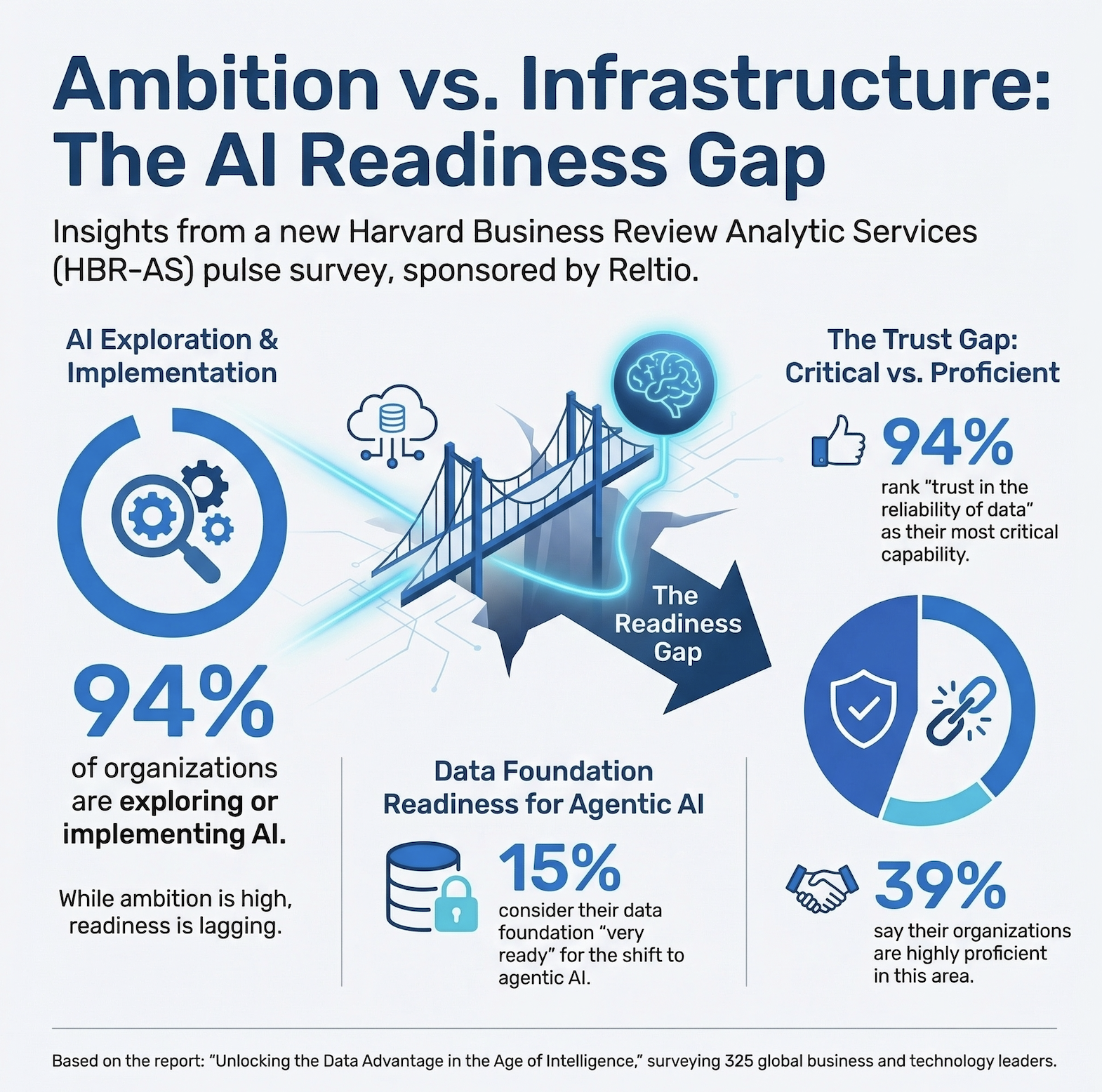
A new pulse survey by Harvard Business Review Analytic Services (HBR-AS), sponsored by Reltio, highlights how wide this readiness gap has become. While 94% of organizations are exploring or implementing AI, only 15% consider their data foundation “very ready” for the shift to agentic AI.
Reltio
Ambition vs infrastructure: the readiness gap
The report, “Unlocking the Data Advantage in the Age of Intelligence,” surveyed 325 global business and technology leaders. The findings show a consistent disconnect between what leaders know they need and what most organizations have built.
The most vital ingredient for AI success? Trust. An overwhelming 94% of leaders ranked “trust in the reliability of data” as their most critical capability. Yet only 39% say their organizations are highly proficient in this area.
When AI agents are empowered to act autonomously, the cost of “bad data” scales exponentially. If the data is fragmented, stale, or conflicting, the AI’s actions will be as well.
Three barriers to agentic AI success
Why is the readiness gap so wide? The HBR-AS research identified three primary hurdles preventing enterprises from realizing the full potential of their AI investments:
- The Persistence of Data Silos: Cited by 46% of respondents, silos remain the top barrier to progress. Agentic AI requires a holistic, cross-functional view of the business. An AI agent cannot optimize a customer journey if it has access only to support tickets and lacks visibility into billing or marketing interactions.
- Strategic Misalignment: Only 16% of respondents say their organization’s data investments are highly aligned with their business strategy. For many, data management is still treated as an ad-hoc IT function rather than a strategic business imperative.
- The Governance Proficiency Gap: While 89% of leaders recognize that data governance is highly important, only 37% say their organization is highly proficient in it. In the Age of Intelligence, governance must evolve from a back-office compliance checklist into a strategic differentiator that ensures data is “AI-ready” in real time.
Context: the decisive ingredient
As Manish Sood, CEO and Founder of Reltio, noted in the report: “Agentic AI represents a step-change in how work gets done, but its autonomy depends on something most enterprises still struggle to scale: unified, real-time, trustworthy data.”
The solution lies in what Sood termed as “Context Intelligence.” To act with precision, AI agents need more than just raw data; they need a semantic layer that acts as a translation guide. This layer defines core business concepts and maps the complex relationships between entities: customers, products, locations, and suppliers across the entire enterprise. AI itself cannot create this guide; it needs a real-time context layer to deliver it.
To move from AI experiments to true business impact, you need more than just data. You need context: a shared, continuously updated understanding of the core entities that run your business and how they relate to each other. A context intelligence layer provides this “system of context” by unifying enterprise data into a dynamic semantic model, allowing AI agents to operate with an accurate, expert-level view of the organization, with less ambiguity and fewer hallucinations.
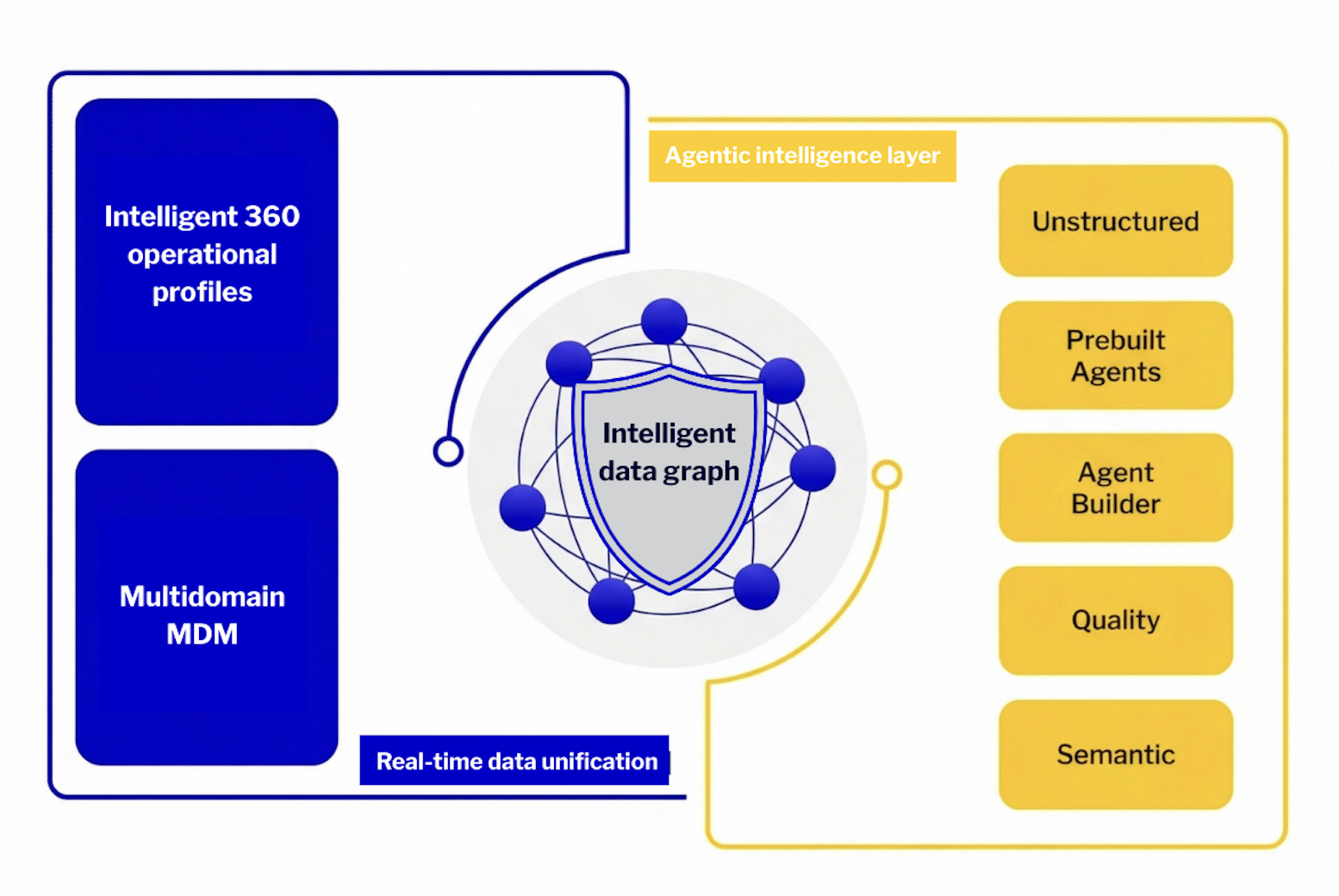
At the heart of this approach is an intelligent data graph: a model that represents entities (such as customers, products, suppliers, and locations) and their relationships. This is what allows agents to “understand” the business more like an experienced employee does, by reasoning over connected relationships rather than isolated records.
Figure 1 illustrates a common way this type of platform is organized: an open architecture centered on the intelligent data graph, powered by two natively integrated pillars. The first is a data unification foundation that delivers secure, high-performance mastering and harmonization across domains (often including multidomain master data management and operational 360 views). The second is an agentic intelligence layer that provides a real-time semantic layer plus purpose-built agents that can work across high-quality structured and unstructured data.
Figure 1: A Context Intelligence platform
Reltio
Together, these capabilities enable the real-time unification of disparate sources and the deployment of trusted agents to automate complex data governance and business operations.
Without this connected, governed, and real-time understanding, even the most advanced AI models will struggle to deliver value with confidence.
Moving from experimentation to evolution
The leaders who win in the era of agentic AI will be those who stop treating data readiness as a one-time project and start treating it as a core organizational evolution. This means moving away from fragmented, ad-hoc data management and toward a platform-based “system of context” that supports agentic transformation across the enterprise.
Explore the new rules of intelligent data. See how industry leaders are unifying trusted data to stay ahead in the AI era.