Connectivity at legacy facilities can present significant challenges for manufacturing companies seeking to optimize operations on the factory floor.
To remedy that, food production giant Cargill is tapping private 5G as a means for unlocking new levels of automation across its extensive system of factories, including the introduction of AI-powered robots.
NTT DATA’s private 5G network will provide the backbone for the company’s factory connectivity strategy, which was launched in March 2025 and covers 50 of its 1,100 facilities as of February 2026. The company plans to add private 5G to more than 100 sites per year.
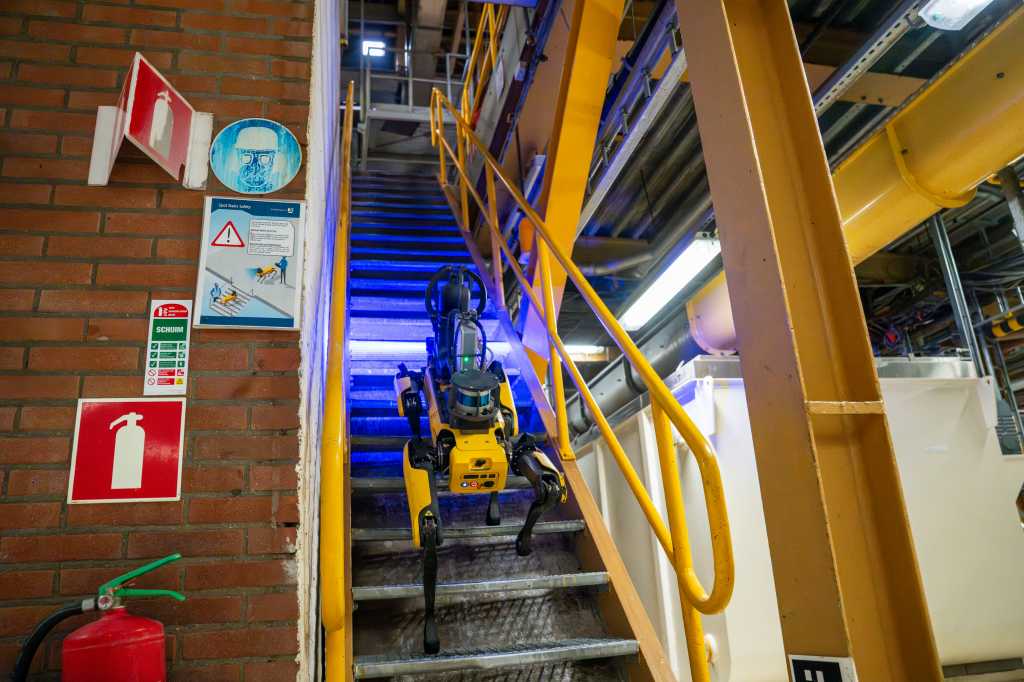
The network provides Cargill with reliable, low-latency connectivity to smartphones and tablets on factory floors and has open the door to experiments with AI-powered robots, including its deployment of Boston Dymanics’ Spot at its Amsterdam facility to automate inspections. The four-legged robot checks for hazards such as overheating equipment and looks for ways to improve worker safety.
Spot roams the factory in a preset pattern and builds a database of information about the conditions it finds there, says Robert Greiner, Cargill’s director of platform engineering for customer, commercial, and business operations digital technology.
“It’ll do vibration tests, it’ll do air quality tests, it’ll do a whole bunch of different measures of what the plant should look like in normal conditions,” he adds. “Because it’s doing that same path every day, it then starts building a database of what normal looks like and what normal doesn’t look like.”
Cargill
Cargill is exploring other ways to bring AI to its factory facilities, many of which are decades old, Greiner says. Reliable connectivity will enable the company to retrofit the buildings with modern sensors.
“Whether it’s a motor that turns or a mill, they generate heat, they have bearings, and they have failures,” he says. “5G has lit up a large area of those plants that didn’t have connectivity out there.”
More coverage
Cargill turned to NTT DATA and private 5G because of challenges with traditional Wi-Fi at many of its factories, Greiner says. In addition to covering a wider area than Wi-Fi routers, private 5G networking provides better connectivity through thick walls and other obstacles than public cellular networks, he notes.
“In the manufacturing environment, when you get outside of what I call a carpeted space, connectivity becomes an issue,” he adds. “Coming out of COVID, with Industry 4.0, there’s been a need for advanced connectivity out there in the plant floor, and our model was struggling to get that connectivity.”
Cargill can now deploy one private 5G network access point to cover the same area as about nine Wi-Fi access points. And while private 5G assess points can cost more than Wi-Fi equipment, additional savings come during installation, with a 70% reduction in cabling and setup costs, Greiner says.
“In our environment we mostly have to run that cabling in conduits, and we have all that infrastructure cost that has to go into the factory floor to enable that access point toward the other side,” he says.
Meanwhile, private 5G gives the company more control over its networks than public cellular networks would, he adds.
“If you’re running on that public network and you’re in the middle of Nebraska, then the school lets out and the school bus pulls up next to the plant and every kid starts streaming data,” he says. “You’re relying on that connection to do some process, but that cell tower could be overrun by the school bus that just happens to be sitting there at that critical time.”
Pen and paper no more
Private 5G also will enable Cargill to update major software platforms and other apps in a secure and reliable way, Greiner says. The company has had several small warehouses sprinkled around the world with no connectivity, and private 5G deployments will allow them to install ERP systems.
“These dark warehouses didn’t have Wi-Fi in them, and they basically were using a No. 2 pencil and a yellow pad for keeping track of the inventory,” he says. “They’re moving to SAP, they have an inventory management system now, and they had the ability to switch over to an electronic inventory system, a warehousing system.”
Cargill took a smart approach to deploying private 5G by approaching it as foundational infrastructure rather than a single-use technology, says Parma Sandhu, vice president of enterprise 5G products and services at NTT.
“Instead of building networks for individual applications, the company deployed connectivity across facilities so multiple use cases — connected worker, robotics, sensors, inspections, and worker tools — can run on the same network,” Sandhu adds. “That approach allows new capabilities to be added over time without rebuilding the underlying connectivity.”
Private 5G can use several slices of the radio spectrum, and NTT DATA works with customers to find the best spectrum for their needs, Sandhu says. Connections can vary from sub-300Mbps to multigigabit speeds, depending on the spectrum used, but throughput isn’t the primary concern on most factory floors, he adds.
“In industrial environments, reliability and consistency matter more than peak speed,” Sandhu says. “Private 5G delivers high capacity and low latency, but the real advantage is secure, predictable connectivity across large facilities with thousands of connected devices. That reliability is what enables automation, robotics, and real-time monitoring on the factory floor.”
Private 5G is gaining traction in manufacturing as factories embrace generative AI, agentic AI, edge AI, and physical AI, Sandhu says. “There has been an explosion in demand for OT data, which requires more compute power and a faster, more reliable, and more secure connectivity,” he adds.
The factory use case
Private 5G makes sense in factory settings, says Jason Leigh, senior research manager for the mobility team at IT analyst firm IDC. While the gap is narrowing, private 5G has given factories more control over network performance than traditional Wi-Fi, and it is also built on a zero-trust security model, he adds.
“If you’re deploying a private network, you can pretty much tune it to say, ‘This network is always going to give me 100 megabits down, 50 megabits up,’” he says. “You can get a little better performance and control who comes on and off the network. “
While outsiders can access a Wi-Fi network if they have the password, private 5G can authenticate at the device SIM level, Leigh says. “It doesn’t matter if you have the password,” he adds.
Private 5G also has advantages as factories adopt more automation and other digital transformation initiatives, Leigh says. While smartphones and tablets running standard applications may not need a specialized network, technologies like AR and VR can benefit.
“Where it gets interesting is when you move towards more automation, more robotics,” he adds. “When you’re running a high-speed factory line and you’re using video to scan for quality issues, with private 5G, you can run that at high speed.”
AI-driven maintenance will need stable connections, he says. “You want that real-time super low-latency connection to exchange the image with the processing and back,” he adds. “You don’t want 10 minutes before the data processing to say, ‘This was an error in this problem, and the product should have been rejected.’”