At a 2027 planning session in October, I watched a leadership team approve three AI agent pilots in under ten minutes. The three were a claims-intake agent, a collections agent and a finance close assistant, each with a sponsor, a vendor quote and a slide of projected savings. The next item on the agenda was the SAP clean-core program those same agents would run on. It took forty minutes, drew questions about payback and slipped to 2028.
Nobody in the room did anything wrong. The agents came in as an operating expense from the innovation fund and were judged on speed to value. The clean-core program came in as a capital project and was judged on a three-year payback—two committees, two tests, one dependency that neither test could see. The agents were funded. The platform they would run on was not.
Versions of that meeting play out in most of the programs I advise, from banks to state Medicaid agencies. It is the planning mistake I see most often this budget season, and you can fix it before January.
Here is the number that should frame 2027. Gartner forecasts worldwide IT spending will reach $7.35 trillion next year, up 15 percent. Much of that growth will never reach your budget directly. By my arithmetic on the forecast’s own table, data center systems add $487 billion ($879 billion to $1.37 trillion), about half of the $961 billion increase, as cloud providers and AI labs build capacity. The same forecast expects “memflation,” its term for AI-driven memory price inflation, to persist through 2027 and push up server and PC prices. Take out the data center build-out and worldwide spending grows 8.6 percent, still more than double typical enterprise budget growth, because it also counts consumer devices and higher hardware prices.
Meanwhile, Gartner’s CIO survey puts average enterprise IT budget growth at 3.7 percent, up from 2.8 percent last year. Gartner notes that, after inflation, that is flat or negative in many countries. Funding for agentic AI rises an average of 31.8 percent, the fastest of any technology area. When one line grows more than eight times faster than the budget that holds it, the difference comes from somewhere else. In the programs I advise, it usually comes from the platform and run budgets agents depend on. IBM’s study of 2,000 technology executives expects AI to rise from just under 15 percent of IT budgets in 2025 to nearly 25 percent by 2027. Yet 85 percent of those leaders still lack full visibility into real-time AI spend.
The providers’ build-out will come back to you, too, as per-token, per-action, and per-user pricing. The real question for 2027 is whether agent money arrives with the money for the platform it depends on.
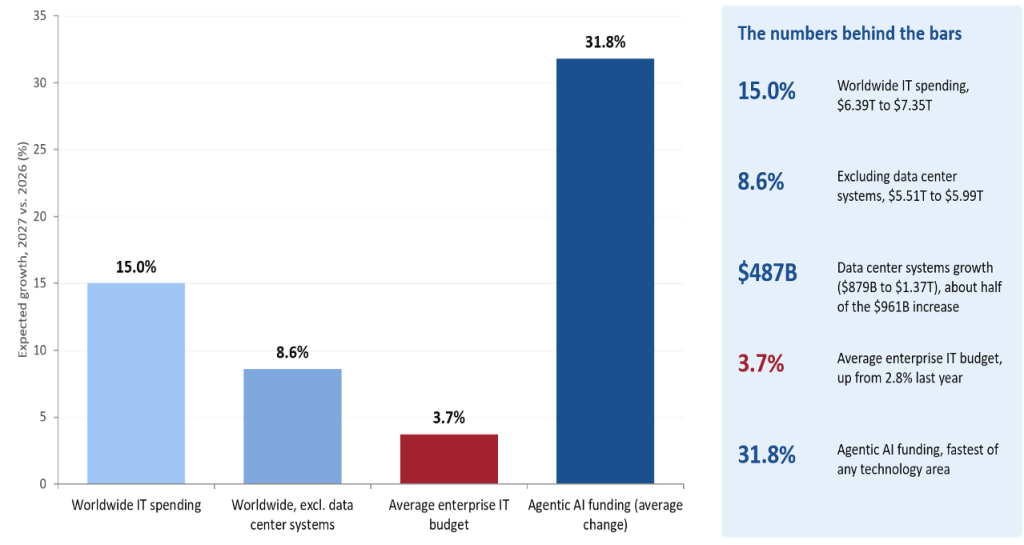
Figure 1. Source: Gartner IT spending forecast (Oct 2026) and Gartner 2027 CIO and Technology Executive Survey.
Vipin Jain
What actually breaks?
When AI and the platforms beneath it are funded on separate tracks, four things break (Figure 2). Each one maps to a discipline your CFO already applies to every other investment, which is why this is a budget problem before it is a technology problem.
Dependency
An agent is funded without the platform work it needs. At a Fortune 500 insurer, finance wanted an intercompany reconciliation agent on SAP. The pilot worked in a sandbox and stalled in production on years of custom code wrapped around the close: user exits, modified standard objects, interfaces nobody had documented. The agent could read the data. It could not act on it through a released API. The business case had counted the license and the build. It had not counted the remediation. The discipline that breaks is total cost of ownership.
The SAP ecosystem has been plain about this. SAPinsider warned in August that custom code, not data, is the hidden blocker for Joule agents, because core modifications turn every quarterly agent update into a re-testing project. SAP’s decision to make Anthropic’s Claude a primary reasoning and agentic capability across its portfolio raises the stakes, not lowers them. If you still run SAP ECC 6.0 on a current enhancement package, mainstream maintenance ends in December 2027. The deadline and the agent now point at the same line item.
Duplication
Every agent rebuilds the same plumbing. At a large bank, the first Salesforce agent carried the full cost of its integrations, test suites and monitoring, and the second team started from zero because nobody had funded those pieces as shared services. Consumption pricing makes duplication visible faster than seat pricing ever did. Salesforce meters Agentforce at $0.10 per action through Flex Credits, so a poorly designed agent pays for every redundant step. The discipline that breaks is amortization. Each agent pays for investments that should be spread across many agents.
Fragmentation
The business context lives in the tools, not in the enterprise. At a healthcare payer, three AI tools ran on three definitions of “authorization.” One sat in the core administration platform, one in a vendor’s prompt library, and one in a spreadsheet maintained by a clinical operations lead. Every new use case meant another round of rework, and every vendor switch would have meant losing the definitions entirely. The discipline that breaks is asset ownership. The most valuable thing an AI program produces is a governed version of what your business means. That is the strategic edge a CEO is paying for, and in the programs, I see, it often sits inside someone else’s product.
Opacity
The organization cannot say what a completed piece of work costs. On a state Medicaid program, the first agent invoices arrived as token counts. Budget officers could see the bill rise but could not connect it to cases processed, backlog reduced or errors avoided. The conversation turned from value to fear in a single meeting. Token prices keep falling, yet in the programs I advise, the cost of a completed task keeps rising as agents add reasoning steps, memory and guardrails. The discipline that breaks is unit economics. Until you can price a completed workflow, you cannot defend one.
In every one of these cases, the agent itself worked. What failed was the funding around it.
Table 1 puts the four cases side by side.
An agent funded without its platform is not an investment. It is an option you have not paid for.
| Industry | Platform | What was funded | What was not | What broke |
| Insurance | SAP, financial close | Intercompany reconciliation agent | Clean-core remediation and released APIs | Dependency. Total cost of ownership understated the build by leaving out the core |
| Banking | Salesforce, sales and service | First agent, built end to end | Shared integration, testing, guardrails and observability | Duplication. Each new agent paid again for the same plumbing |
| Healthcare payer | Core administration and two AI tools | Three AI tools, each with its own prompts | One governed definition of authorization | Fragmentation. The business meaning lived in vendor tools, not in the enterprise |
| State Medicaid | Eligibility and case management | Case-processing agents billed by tokens | Cost per case and staged autonomy decisions | Opacity. Budget officers could see the bill but not the value |
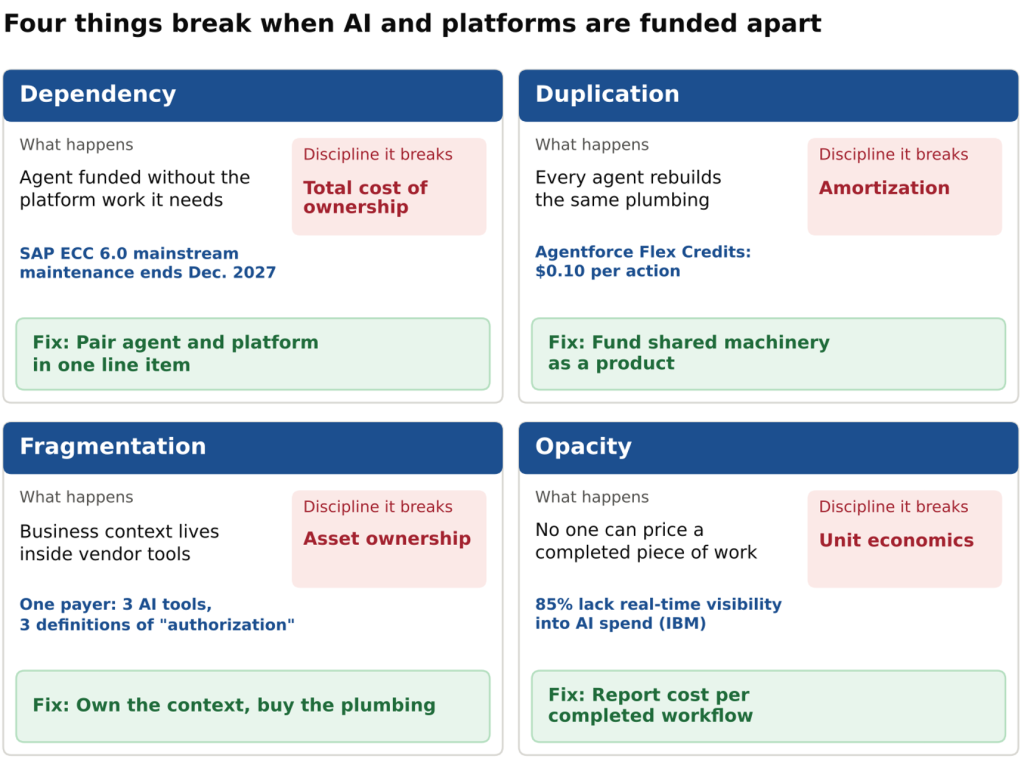
Figure 2. Four things break when AI and platforms are funded separately, and the discipline each one breaks. Evidence lines: SAP, Salesforce and IBM published figures.
Vipin Jain
Why doesn’t the budget process catch it?
Because it works exactly as designed. Most enterprises run two investment paths. Innovation money moves fast, tolerates uncertainty and rewards visible pilots. Platform money moves slowly, demands payback and rewards risk reduction. Agents travel the first path. Clean core, integration and data foundations travel the second. Neither process asks whether one depends on the other.
The pricing models make the comparison harder. Microsoft prices Agent 365 at $15 per user per month. Salesforce sells Agentforce through per-action Flex Credits. Model providers price by token. Platform work is priced in project hours. A budget committee looking at those four units cannot tell which costs belong to the same outcome, so it approves them one at a time.
Ownership has drifted too. Deloitte found in its survey of 3,500 leaders that 40 percent of companies already let AI execute decisions or actions without human approval to at least a moderate degree. For 23 percent, accountability for a bad outcome remains unclear, and an agent nobody owns has no budget owner either. The Cloud Security Alliance reports that 82 percent of organizations have discovered previously unknown agents in the past year, and only 21 percent have a formal process for decommissioning them.
The public sector feels it most sharply. The 2026 NASCIO State CIO Survey found that only 28 percent of state CIOs have dedicated funding for AI initiatives. CIOs are again calling for a move away from the inflexible chargeback model that bills agencies for IT services. Chargeback was built for a world where a person in one agency consumed one service. An agent working a case across three agencies does not fit that model, and neither does its bill.
What has the market already conceded?
What strikes me most this year is how quickly everyone converged. Model makers, platform vendors, cloud providers, service firms, standards bodies and analysts landed on the same message within months, as Figure 3 shows. Each has conceded that agents need a control plane, shared context and cost management underneath them. Each would like that layer to be its own. The agents are productized. The foundation is where the competition and your bill now sit.
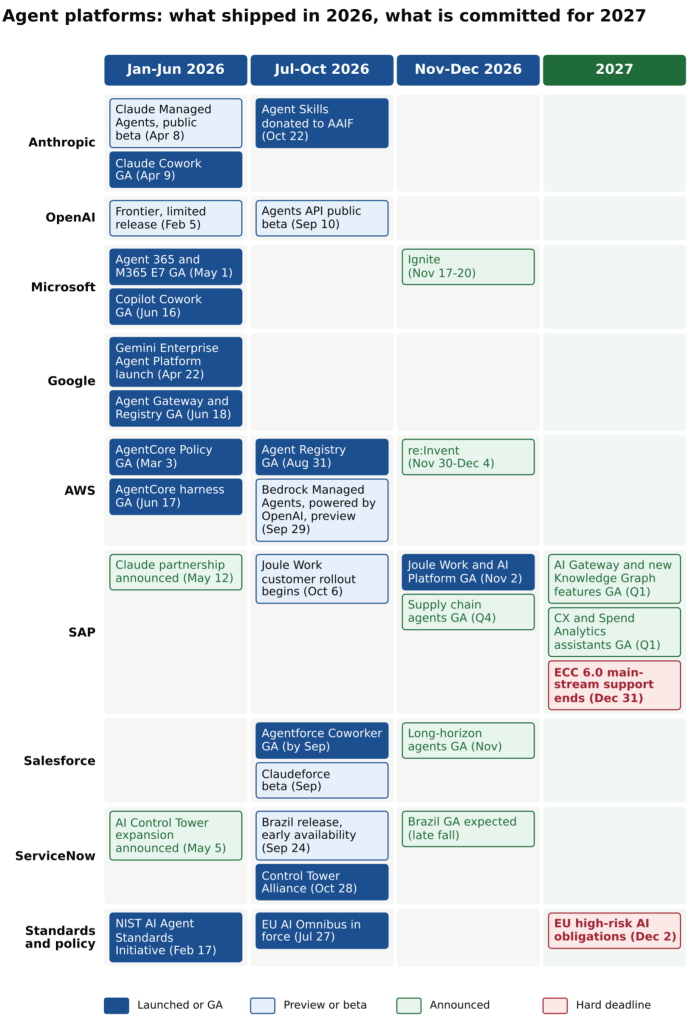
Figure 3. Enterprise agent platforms: what shipped in 2026 and what is committed for 2027, as of November 9, 2026. Sources: Anthropic, OpenAI, Microsoft, Google, AWS, SAP, Salesforce and ServiceNow announcements; ERP Today and CIO.com for SAP’s 2027 dates; ServiceNow Community for Brazil GA timing; NIST; EUR-Lex.
Vipin Jain
The platform vendors moved fast. In April, Google introduced the Gemini Enterprise Agent Platform, the evolution of Vertex AI, to run and govern agents at scale. Microsoft made Agent 365 generally available on May 1 as a control plane for agents built in Copilot Studio, Foundry and beyond. At Knowledge 2026 in May, ServiceNow announced an expanded AI Control Tower to govern agents wherever they run. SAP followed at Sapphire in May with its Anthropic partnership. By Dreamforce in September, Salesforce had Agentforce Coworker generally available and Claudeforce, its Anthropic partnership, in beta. OpenAI launched Frontier in February to build, deploy, and manage what it calls AI coworkers, initially for a limited set of customers. In September, AWS moved Amazon Bedrock Managed Agents into preview. It is an AWS service, developed jointly with OpenAI.
The service firms followed the gap. Anthropic, Blackstone, Hellman & Friedman and Goldman Sachs launched an enterprise AI services firm in May. When a model maker helps fund implementation capacity, it signals the bottleneck has shifted from the model to the enterprise around it.
Standards and trade groups are filling in the rest. The Agentic AI Foundation under the Linux Foundation already hosts MCP, and in October Anthropic donated its Agent Skills standard to it. The FinOps Foundation reports that 98 percent of its survey respondents now manage AI spend, up from 63 percent in 2025 and 31 percent in 2024. Managing a bill is not the same as seeing it in real time, which is the 85 percent gap IBM found.
The analysts read the same signals. Forrester issued the sharpest warning, calling SAP’s Autonomous Enterprise vision credible. In the same breath, it warned that anchoring on Claude creates concentration risk that becomes a board-level issue in regulated industries within 24 months. McKinsey’s guidance to banking CIOs describes a North American bank where each new agentic coworker inherits the infrastructure, controls and lessons learned from the ones before it.
Looking forward, the dated commitments cluster early. Salesforce said at Dreamforce that its long-horizon agents would reach general availability in November. SAP plans general availability for the SAP Enterprise AI Gateway and new SAP Knowledge Graph capabilities in the first quarter of 2027. Two hard deadlines then close the year: SAP ECC mainstream maintenance and the EU’s high-risk AI obligations, both in December 2027. Most vendors have not published anything firmer for 2027, which is itself a planning signal. Fund for capabilities you can see shipping, and treat everything else as an option.
That has a commercial edge. When several vendors compete to run the same workflow, your bargaining power comes from portability. Ask every vendor in your 2027 renewals whether its agents speak MCP, whether agent definitions and logs can be exported, and what it costs to move a workflow to another platform. A vendor that cannot answer is pricing in your lock-in.
Does the political climate change the plan?
Mostly, it changes the timing. In Europe, the Digital Omnibus on AI, in force since July 27, moved the AI Act’s stand-alone high-risk obligations from August 2026 to December 2, 2027. Obligations for AI embedded in regulated products moved from August 2027 to August 2028. The new date lands inside your 2027 roadmap. In the United States, the December 11, 2025 executive order launched a federal push to preempt state AI laws, but as of late October, Congress had not enacted any federal preemption. Until Congress or the courts settle it, plan for state AI laws to keep applying.
Cost has a policy side too. Tariffs add volatility to hardware already squeezed by memflation, so price next year’s refresh with a buffer. Data sovereignty rules increasingly determine where an agent may run and which model it may call, which is another reason to keep models swappable. In the public sector, the November 3 elections produced 19 new governors, and only 40 percent of state CIOs keep their jobs through a governor transition. Many 2027 state CIOs will inherit agent programs funded under someone else’s assumptions.
The practical answer is architectural. Build controls into the platform once and configure them by jurisdiction, rather than building compliance into each agent. Programs built this way absorb a new rule with a configuration change, not a rebuild.
Where should CIOs start?
None of this requires a new governance body. The leaders I see getting ahead are doing six things in order, starting with the two or three workflows where they can afford to learn.
- Start from the business plan, then tag every AI dollar to a workflow. Begin with the three or four outcomes on the CEO’s 2027 plan, not with the AI backlog. Then attribute existing AI spend to the business process it serves before approving anything new. IBM found that organizations with strong AI financial discipline deploy 2.4 times more AI agents with no higher AI or IT budget.
- Pair every agent with its platform dependency. One line item, one accountable owner, one business case that includes the clean-core, integration or data work the agent needs, whether the platform is SAP, Salesforce or ServiceNow. This is the change that fixes the insurer’s close.
- Fund the shared machinery as a product. The integration layer, test suites, guardrails and monitoring get their own budget and product owner, and every new agent consumes them. The test is simple: the second agent should cost less than the first.
- Own the context, buy the plumbing. Buy models and orchestration from the market, whether Anthropic, OpenAI, Google, Microsoft or Amazon, and keep them swappable. Build your business vocabulary once, govern it like a data product, and keep it in-house. At the payer, one governed definition of authorization ended the rework that came with every new use case.
- Release autonomy in stages. As Figure 4 shows, start with a human approving every action, move to sampled review as accuracy holds, then to exceptions only. Record each step as a decision with supporting evidence. Plan the role changes in the same quarter, or the agent will quietly redesign them for you. Deloitte reports that 60 percent of companies have redesigned jobs around AI to at least a moderate degree, but only 15 percent describe the change as extensive or complete.
- Price by the completed workflow, and retire something every quarter. Report cost per case, per claim or per close, not per token. Use the savings from retired custom code, duplicate tools and failed pilots to fund the next step.
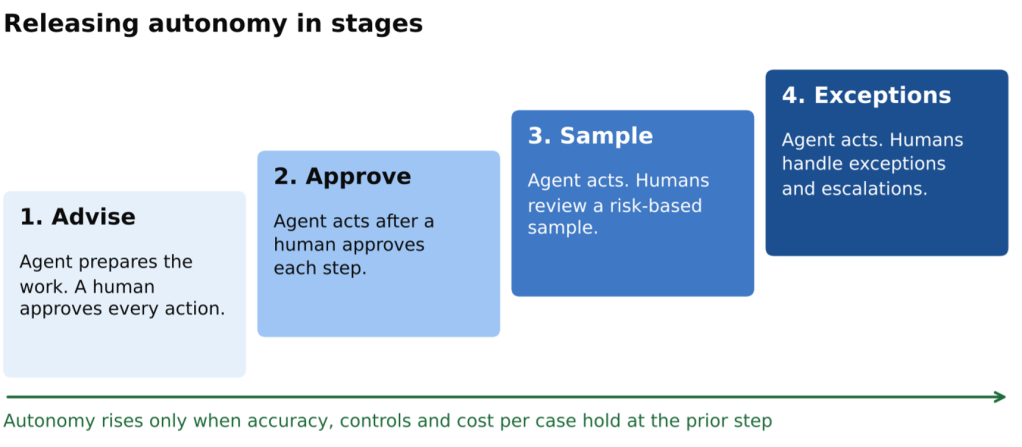
Figure 4. Releasing autonomy in stages.
Vipin Jain
The gates between those steps are what make the roadmap real. On the Medicaid program, moving from full approval to sampled review required three months of accuracy data and a cost per case inside target. Moving to exceptions only requires a recorded decision by the program director. When we started reporting cost per case processed, the budget conversation moved from fear of the bill to the value of the work. In the public sector, where every dollar is appropriated, and every decision about a beneficiary can be audited, that evidence is what makes an agent defensible in front of a legislative committee.
Figure 5 shows the shape of a balanced 2027 roadmap, adapted from the ones I am building with clients now. Every quarter, fund AI and platform work together, and every quarter ends with a gate.
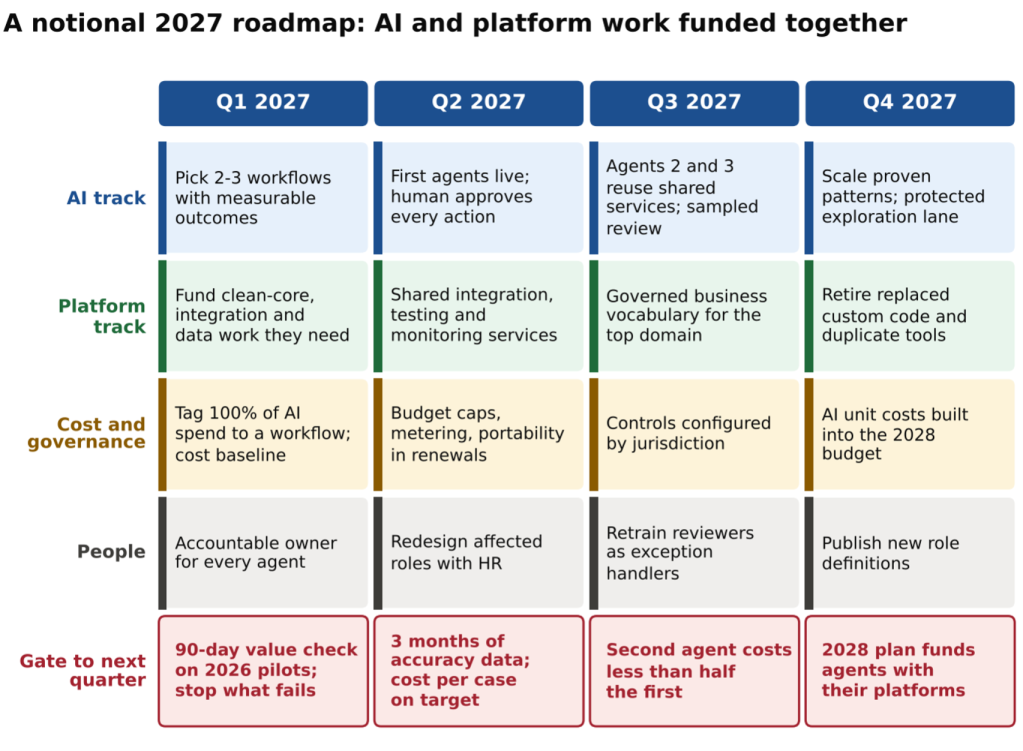
Figure 5. A notional 2027 roadmap: AI and platform work funded together.
Vipin Jain
Take the roadmap to the board as one portfolio with three numbers: the share of AI spend tagged to a workflow, the cost of a completed workflow and the cost of each new agent compared with the first. If those three move in the right direction each quarter, the program is working, regardless of the agent count.
The takeaway
The CIOs who come out of 2027 ahead will be the ones who funded agents and platforms in the same line and made every agent cheaper than the last. That reframes the job for this planning cycle: half portfolio manager for AI bets, half architect of the platforms those bets run on.
It also means saying no in the budget meeting. Decline the agent that arrives without its platform dependency funded. Decline the clean-core program that arrives without an agent or a business outcome attached.
None of this is new. It is the pattern I have watched for thirty years, from trading floors to Medicaid programs. When business strategy, technology and the way people work are planned on separate tracks, technology industrializes the gap between them. Agents industrialize it faster.
So, ask your team three questions this week. None of them requires a program to answer.
| Ask your team | A good answer sounds like |
| Is the platform work behind each AI initiative in our 2027 plan funded, and does one person own both? | A single line item per workflow that names the agent, its platform dependency, one owner and one business case |
| Will our second agent cost less than our first? If not, what are we rebuilding each time? | A list of shared services every agent consumes, and a cost comparison between the first agent and the second |
| What does one completed workflow cost us, and who sees that number every month? | A cost per case, claim or close, reported to finance and the business owner, with a target for next quarter |
The agents are ready. Fund the platform they will run on.
This article was made possible by our partnership with the IASA Chief Architect Forum. The CAF’s purpose is to test, challenge and support the art and science of Business Technology Architecture and its evolution over time, as well as grow the influence and leadership of chief architects both inside and outside the profession. The CAF is a leadership community of the IASA, the leading non-profit professional association for business technology architects.