AI is entering a phase of sustained enterprise adoption. As the technology rapidly advances, organizations are moving beyond isolated use cases and short-term efficiency gains and rethinking how they use AI to create value, meet changing customer expectations and evolve their operating models over the next several years.
That requires a clear end goal, an honest assessment of current capabilities and a practical roadmap for moving from today’s reality to that end goal.
Today, we are seeing five accelerating trends shaping how that transition is unfolding.
LLMs are evolving into AgenticOS platforms
Horizontal LLM providers like Anthropic and vertical AI companies like Harvey are moving beyond standalone AI models and building broader enterprise platforms. These platforms combine AI models with workflows, playbooks, integrations and governance tools inside a single environment, which are beginning to be described as an “AgenticOS.” As a result, the market is beginning to consolidate around a smaller number of platform providers that can simplify procurement, integration, spend management and data privacy compliance.
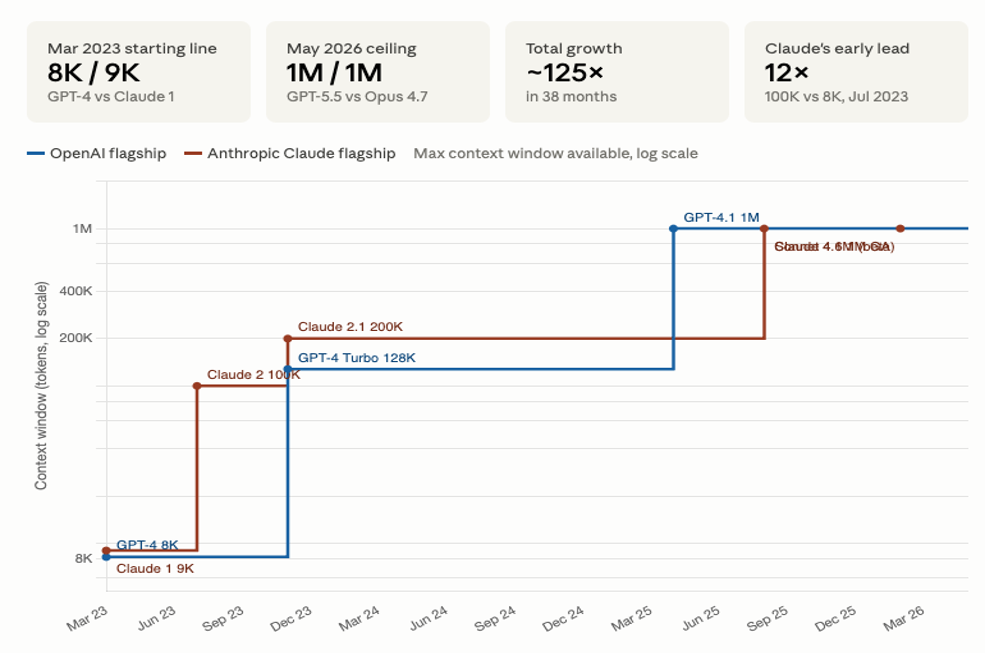
Context windows have expanded by orders of magnitude
Leading AI models can now process dramatically more information at once than they could just a few years ago, with the amount of information they can analyze in a single interaction expanding roughly 125× since 2023. That shift is making more complex, enterprise-scale work, like large-scale contract review, codebase-wide analysis and multi-document research synthesis, possible. Such capabilities, which once felt cutting-edge, are becoming standard expectations.
John Wei
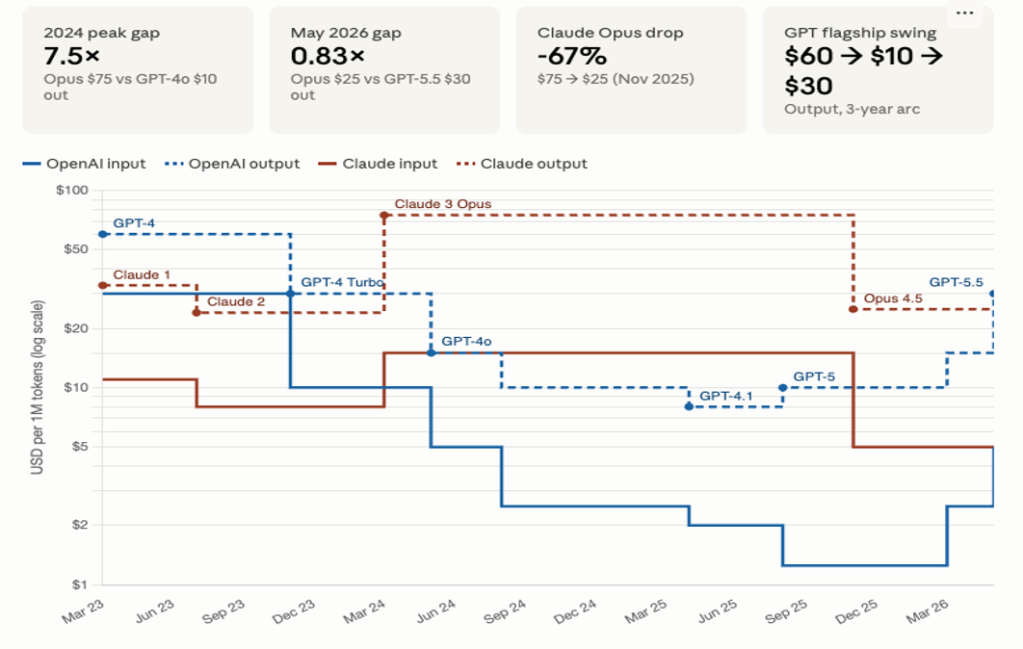
Token pricing has stabilized at the production tier
After dropping rapidly between 2023 and 2025, the cost of using mainstream AI models has started to stabilize. Today, many enterprise-grade models fall within a relatively predictable range of roughly $2–$3 per million input tokens and about $15 per million output tokens, making costs easier to anticipate and manage.
At the same time, cost-saving features like prompt caching (which can reduce costs by up to 90%) and batch APIs (which can cut costs by roughly 50%) are making AI significantly cheaper to operate at scale. Together, those shifts are making AI spending easier for enterprises to budget, forecast and manage like other core technology investments.
John Wei
AI is functioning as a productivity assistant, not a human replacement.
I had the chance to speak with senior leaders at this year’s WSJ Future of Everything conference, and one theme consistently emerged: despite the hype around AI agents, many companies are still using AI to support human decision-making rather than replace it.
Data shared by the senior leadership team of a prominent AI company at the WSJ conference shows that AI agents consume less than 5% of tokens today, and 84% of enterprise use cases are growth-focused rather than productivity-focused. That is largely because AI workflows still depend heavily on the quality and consistency of inputs. In complex enterprise environments with variable scenarios and edge cases, human judgment, prompt refinement and iterative review remain essential.
As a result, workflows can rarely be fully automated, and many automation gains translate into incremental productivity improvements rather than meaningful headcount reduction without broader operating model changes.
Instead, many organizations are using AI to drive growth, support new business models and enable new ways of operating.
Software development is the leading edge of human-AI collaboration.
In our experience at Integreon, vibe coding has produced a few notable success stories. At enterprise scale, though, it can introduce architectural limitations and sometimes even hardcoding or semi-hardcoded shortcuts that undermine the long-term sustainability of the code. As a result, we primarily use AI coding tools as developer assistants for targeted tasks rather than end-to-end software development. That approach reflects a broader industry trend: despite high-profile tech layoffs, overall demand for developers has remained steady, and demand for developers with AI skills is rising.
Across all five trends, the focus has shifted from automating legacy workflows to assisting human workflows. This is a fundamental change in how work will be organized across the enterprise.
As AI technologies mature and become widely accessible across industries, competitive advantage will increasingly come from strategy rather than the technology itself. Many businesses will have access to the same AI platforms, models and tools. What will differentiate organizations is how they apply those technologies to shape customer experience, operating models and market positioning.
The airline industry offers a useful parallel. Most airlines operate similar aircraft under the same regulatory and labor constraints, yet they differ dramatically in market positioning, customer experience and operational performance. What separates airlines is not the plane itself, but how the business is built around it.
For CIOs and CTOs, choosing an AI platform is no longer the main challenge. The more important conversations now center on where the business is headed and how AI supports that strategy. Leaders must ask themselves questions like:
- Who do we want to become? Most enterprises have mission statements, but far fewer know exactly where they want the business to go over the next three to five years as AI reshapes customer expectations, competition and economics. That answer needs to be concrete enough to guide real decisions.
- What are we choosing not to do? Strategic restraint matters just as much as strategic ambition. AI lowers many costs, making it tempting for organizations to spread themselves across too many initiatives. But without clear boundaries, organizations risk stretching resources too thin.
- Where are we today? That means taking a real look at which parts of the business AI may shrink or disrupt over the next three to five years. Many companies struggle to assess this honestly because those areas still generate revenue today. Sometimes it takes an outside perspective to spot risks internal teams are too close to see.
- What capabilities do we need to succeed three to five years from now? Companies often plan by projecting today’s business forward instead of starting with where they want to end up. Usually, the answer comes down to a few key differentiators, like proprietary data, customer trust or distribution, along with a broader set of capabilities that simply need to be strong and reliable.
- How will we organize work? Enterprises must rethink how work gets done. Most operating models today were built around human labor. Going forward, many workflows will likely be shared between AI systems and human oversight.
- What kind of talent do we need? This can be especially difficult for companies with long histories and established teams. Employees who drove success in the past may not align perfectly with where the business is headed next. Companies will need to think carefully about how experienced employees can help build and support future capabilities.
- Where can we simplify workflows? In many cases, workflows can be reduced to three core steps. First is building context, including defining the goals, data, constraints and decision-making framework. Then comes AI execution, where AI is applied to workflows and tasks. Finally, humans review outputs and make judgment calls.
- Which AI platforms do we actually need? Most enterprises do not have the capacity to effectively manage dozens of AI vendors and tools at once. Every additional platform adds more integration work, governance, vendor oversight and security review requirements. In most cases, organizations are better off making a small number of focused platform bets than constantly chasing the latest AI tool.
Finally, a few thoughts on what to avoid
The best mentors I’ve had taught me to think in three-to-five-year terms. A good strategy should remain relatively stable over that period. Without that consistency, organizations end up resetting direction too often and losing credibility in the process.
Today, I see two common mistakes. The first is staying too anchored to the past, defaulting to reasons something cannot happen because of security, compliance or organizational resistance. The second is the opposite: chasing every new technology simply because it is new. Most enterprises will need to find a middle ground over the next several years.
AI is the aircraft. Strategy is the route.
The companies that pull ahead will not necessarily be the ones spending the most on AI or launching the most pilots. They will be the ones whose leaders answered the hard questions, stayed committed to a direction and learned from mistakes along the way.
Technology will continue to change. Strategy is what will determine who uses it well.
This article is published as part of the Foundry Expert Contributor Network.
Want to join?