Due to the rapid evolution of generative AI in recent years, many companies are accelerating their adoption of AI. Specifically, the scope of AI’s integration into day-to-day operations is steadily expanding, covering tasks such as minute-taking, summarization, searching, responding to inquiries, and drafting documents — all of which are typically performed by white-collar workers in office settings. At the same time, however, as discussions about AI adoption intensify, questions and concerns are emerging in society, such as “What will happen to human jobs?” and “To what extent should we entrust tasks to AI?”
My own fundamental premise when considering the roles of humans and AI is that AI should not be viewed merely as a tool for improving efficiency. The core issue that a CIO must fundamentally address is not which tasks to introduce AI into, but rather to thoroughly consider what roles humans and AI should each play, how they can complement one another, and how they can enhance each other to create new value that was previously unattainable.
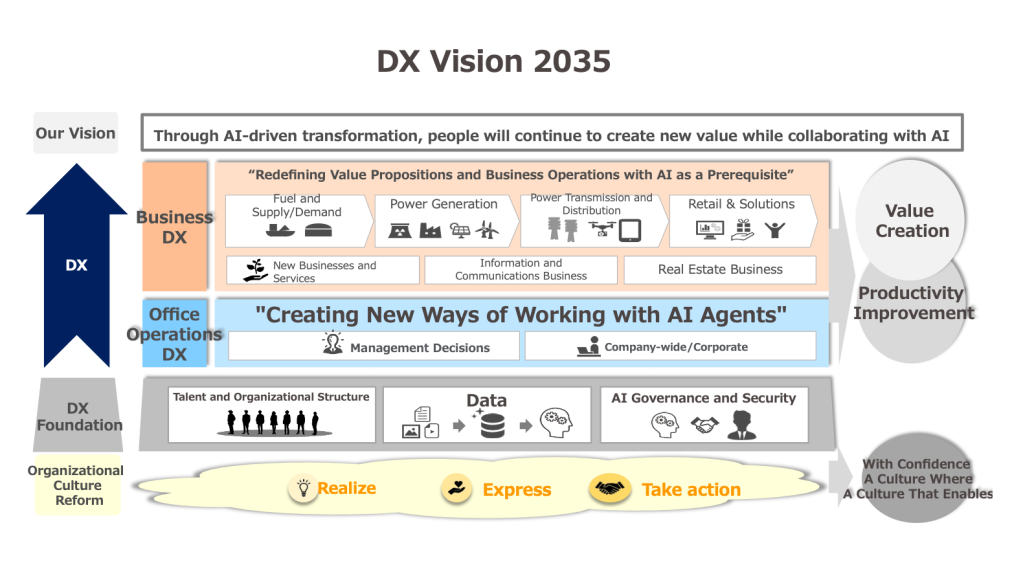
The Kansai Electric Power Group’s DX Vision 2035 — as part of its DX and AI strategy — has clearly defined its vision as continuing to create new value through AI-driven transformation, with people collaborating with AI. The underlying philosophy is that the use of AI is by no means merely an improvement along the lines of conventional practices; rather, it aims to achieve a fundamental restructuring of business, operations, and work styles.
Akio Ueda
Thus, collaboration between humans and AI does not mean replacing part of the work with AI but rather identifying the strengths of both humans and AI, and restructuring workflows, decision-making, and value delivery. I believe that only when this is achieved will AI evolve from a mere convenient tool into an indispensable weapon for corporate transformation.
What is AI good at, and what should humans take on?
The starting point for considering human-AI collaboration is to objectively assess the areas in which each excels.
AI excels at rapidly analyzing, processing, searching, and summarizing large volumes of information, presenting multiple options, and making inferences and evaluations based on established patterns. For example, gathering external information, drafting documents, preparing meeting minutes, reviewing contracts, responding to inquiries and creating preliminary risk assessments are areas where AI can demonstrate significant strength.
In fact, at Kansai Electric Power, the use of AI is accelerating across a wide range of use cases, including AI-powered compliance checks, AI critic agents for meeting agenda items, AI risk assessment agents for investment projects, the enhancement of the internal help desk through AI, and the overall reform of corporate sales processes through AI.
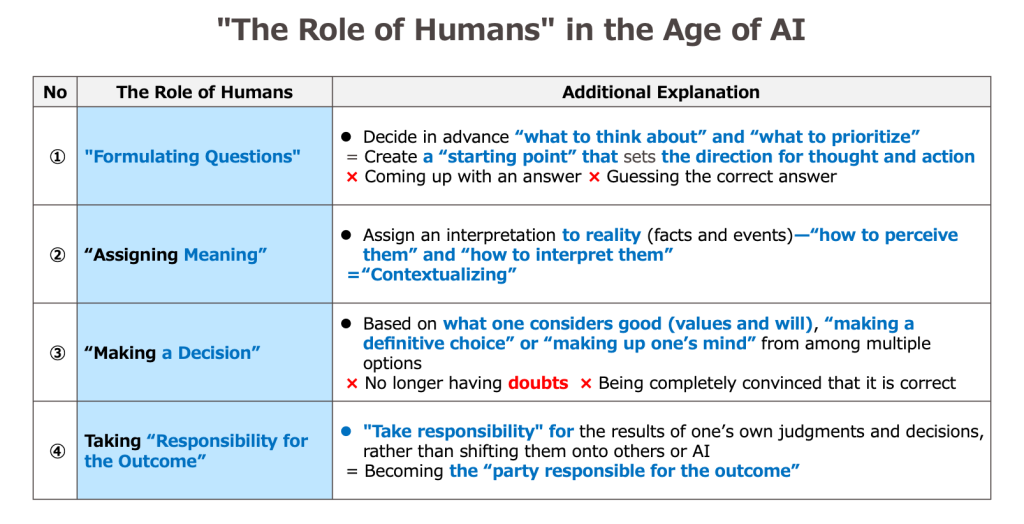
On the other hand, I believe that in the age of AI, humans should assume four key roles:
- Formulating questions
- Interpreting meaning
- Making decisions
- Taking responsibility for the results
While AI can present a vast number of options, it cannot bear the responsibility for making judgments such as “What do we value?” or “What should this company choose?” This is particularly true in the fields of management, customer service, and organizational operations, where factors such as ethics, trust, emotions, and the balancing of interests come into play. In such contexts, human will is ultimately the guiding principle.
Akio Ueda
In other words, humans are the ones who decide what questions to ask and what choices to make, while AI is, at best, a tool that quickly produces processing results. If we proceed with AI adoption while blurring this division of roles, it will lead to confusion on the front lines. Conversely, if this distinction is clearly established, AI implementation will not undermine front-line capabilities but will instead enhance human capabilities.
Collaboration is not about division of labor but mutual reinforcement
An important point to note here is that collaboration between humans and AI cannot be achieved simply by creating a basic division of labor chart. What matters is designing a relationship in which both parties draw out and enhance each other’s strengths.
Kiichiro Toyoda, the founder of Toyota Motor Corporation, once said, “Machines become complete when they become one with humans.” If we replace machines with AI in this quote, it becomes “AI becomes complete when it becomes one with humans.” I believe this expresses a timeless concept that remains fully relevant even in today’s AI- era.
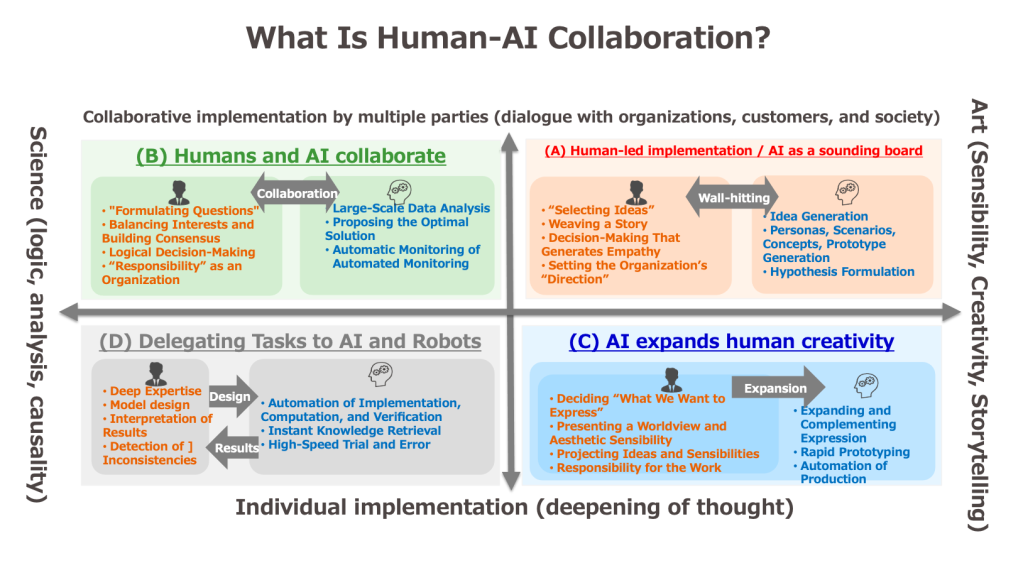
So, what are the different patterns of human-AI collaboration? Below, I’ve created a four-quadrant matrix chart that categorizes how humans work based on Science vs. Art (horizontal axis) and Individual vs. Collaborative (vertical axis).
Akio Ueda
For example:
- [Quadrant D] Science × Individual Work ⇒ Tasks are entrusted to AI and robots.
- [Quadrant C] Art × Performed Individually ⇒ AI expands human creativity.
- [Area B] Science × Individually ⇒ Humans and AI collaborate
- [Domain A] Art × carried out collaboratively by multiple people ⇒ Carried out primarily by humans; AI serves as a sounding board
This is the breakdown.
The accuracy of AI’s output changes significantly depending on the quality of the questions humans pose to it. Conversely, when AI anticipates needs by organizing key points and gathering information, humans can devote their time to making more fundamental decisions. At Kansai Electric Power, a proof of concept (PoC) is underway to utilize AI agents for brainstorming management decisions, risk assessment, and stimulating discussion. This initiative is being pursued not with the idea of handing over work entirely to AI, but rather with the concept that AI extends human thinking and enhances the quality and speed of human decision-making.
As this collaboration progresses, the very nature of work will change.AI will take on the tasks of gathering, organizing, and analyzing information — tasks that humans previously spent a great deal of time on — allowing humans to focus on formulating questions and hypotheses, engaging with customers, being creative, building consensus, and making final decisions. As a result, we will see not just a reduction in man-hours, but an improvement in the quality and speed of work.
Thus, I believe we are moving toward a world where people and companies that make full use of AI will succeed, while people and companies that do not use AI will fall behind — not a world where AI takes people’s jobs.
The fundamental question a CIO should ask is not “What should we have AI do?” but rather “What will people be able to focus on once AI is introduced?” I believe that the ultimate value of collaboration lies not in the adoption rate of AI, but in the enhancement and acceleration of human work.
Business process redesign is essential for achieving collaboration
A common trait among organizations where AI adoption is not progressing as expected is that they introduce AI only to specific parts of their operations without changing the underlying processes or methods of human work. While this may seem like the easiest approach at first glance, it actually results in the least effective use of AI’s capabilities and minimizes the value it can deliver. In short, while JTCs (traditional Japanese companies) think in terms of where to introduce AI based on existing business processes, AIFCs (AI-first companies) rebuild business processes on the premise that AI exists.
To truly realize collaboration between humans and AI, it is necessary to break down the business processes themselves. This involves visualizing the elements within the work—such as problem definition, data collection, organization, decision-making, dialogue, resolution, evaluation, and improvement—and designing and transforming each step to determine whether it should be entrusted to AI, handled by humans, or carried out collaboratively by both. This is not merely the introduction of AI, but the design and transformation of the business, its operations, and its organization.
At Kansai Electric Power, there are use cases such as the transformation of the entire sales process using AI, support for knowledge and technical succession in the thermal power division, support for regulatory compliance checks, and the enhancement of the internal help desk. However, we believe the significance lies in the fact that this is not merely the introduction of AI or partial optimization, but rather the integration of AI after taking a bird’s-eye view of the entire workflow, with the ultimate goal of achieving overall optimization.
Thus, the CIO must act not as the person responsible for AI implementation, but as the architect of business transformation.
The CIO is a collaborative designer, not an AI implementation manager
The role expected of a CIO in the AI era is not merely to drive AI adoption. It is to envision a future where humans and AI work together, and to translate that vision into implementable business processes, systems, rules, and organizational culture.
In this sense, it can be said that the CIO is not an AI implementation manager but a collaborative designer. What should humans specialize in, and in which areas should AI be used? What should humans take on more heavily, and what should they let go of? Continuously answering these questions is the CIO’s essential job.
Moreover, this design is not a one-time effort. As long as AI itself continues to evolve rapidly, the nature of collaboration will also continue to evolve. That is precisely why a CIO should not be the one who provides the right answers, but rather the one who continually asks the right questions. The key is not how much to entrust to AI, but rather what humans should hone in an era where AI exists. Continuously asking this question is what determines a company’s competitiveness.
Beyond collaboration lies a relationship where humans and AI enhance each other
When people hear the term human-AI collaboration, many likely think first of efficiency and increased productivity. However, the true goal lies beyond that. It is not merely about using AI to reduce human workloads but about using AI to expand human potential.
Rather than humans merely mastering AI, we must create a relationship where humans and AI mutually enhance one another. Only when such collaboration becomes firmly established will companies truly gain a competitive advantage in the AI era.
The future that CIOs should envision is not an organization where AI takes away people’s jobs. It is an organization where, with AI as a partner, people can engage with customers and society in a more creative, more meaningful way.
What does collaboration between humans and AI entail?
We must not leave this question vague but rather think it through thoroughly and bring it to fruition.
Is this not the crucial mission entrusted to the CIO in the AI era?
This article is published as part of the Foundry Expert Contributor Network.
Want to join?