Most articles about AI Centers of Excellence (CoEs) focus heavily on organizational structures, steering committees and high-level governance models. They explain why enterprises need an AI CoE, but they rarely address the far more difficult challenge of how successful organizations operationalize AI at enterprise scale. In practice, many of these discussions remain theoretical, emphasizing aspirational maturity frameworks without addressing the operational complexities organizations encounter once AI systems move into production.
This article takes a different approach by grounding the discussion in real-world enterprise implementation experience. Rather than relying on abstract models, it draws from operational lessons learned while deploying production AI systems across industries. The guidance is informed by governance practices that have successfully passed security and compliance reviews, operational realities associated with managing large language models (LLMs) and AI agents after deployment, and practical implementation patterns observed across enterprises scaling AI initiatives beyond experimentation.
Instead of presenting an idealized roadmap, the article focuses on the foundational capabilities consistently implemented by organizations that have successfully operationalized AI at scale. These enterprises are not simply experimenting with isolated AI pilots; they are deploying enterprise-grade AI agents, Retrieval-Augmented Generation (RAG) systems, copilot platforms, multi-agent orchestration frameworks and comprehensive AI governance models. Equally important, they are establishing disciplined AI application lifecycle management processes that ensure AI solutions remain secure, observable, maintainable and aligned to measurable business objectives over time.
At the center of this article is a key thesis: the most successful AI Centers of Excellence do not begin with innovation labs or experimentation theater. They start by establishing the operational foundations required to scale AI responsibly across the enterprise. These foundations include operational governance, enforceable security controls, standardized approaches to data grounding, rigorous evaluation disciplines and mature LLMOps and observability capabilities. Together, these disciplines form what can best be described as the enterprise “AI operating system”, a repeatable operational framework that enables organizations to deploy AI securely, govern it consistently and scale it sustainably across the business.
Why traditional AI CoEs fail
Traditional AI Centers of Excellence (CoEs) often fail because they become innovation-focused organizations that lack operational accountability. In many enterprises, the CoE evolves into a disconnected strategy function that produces prototypes, frameworks and vision documents without establishing the operational foundations required to scale AI responsibly. These organizations frequently lack ownership of production deployments, standardized implementation practices, observability frameworks, security enforcement mechanisms, and measurable business outcomes. As a result, AI initiatives remain experimental rather than becoming integrated, governed capabilities that deliver sustained enterprise value.
Another major failure pattern is the rapid proliferation of shadow AI across the organization. Without centralized governance and architectural oversight, business units begin deploying isolated copilots and standalone AI solutions independently. This fragmentation creates inconsistent user experiences, duplicate investments and increased operational costs as multiple teams unknowingly build similar capabilities. More critically, the absence of standardized governance introduces significant security and compliance risks, including sensitive enterprise data leaking into prompts, uncontrolled model usage and expanding regulatory exposure. Over time, the organization accumulates uncontrolled AI sprawl that becomes difficult to secure, monitor or optimize.
Many organizations also become trapped in what is commonly referred to as “pilot purgatory,” where AI initiatives never progress beyond experimentation into scalable production solutions. This typically occurs because no formal evaluation framework exists to measure success, no ownership model is defined between business and IT teams, and security approval processes remain unclear or inconsistent. Compounding the problem, AI architectures are often developed independently across teams without standardized patterns or governance controls. Without clearly defined business KPIs tied to measurable outcomes, leadership struggles to justify broader investment or operationalization. The result is an organization with numerous AI pilots but little enterprise-wide adoption, governance or measurable business impact.
A reference model
This perspective is informed by a recent field engagement to design an AI and agentic Center of Excellence (CoE) for a global enterprise software organization, and reflects patterns consistently observed across AI readiness assessments, data maturity evaluations, executive workshops and production-scale deployments.
While no two AI Centers of Excellence are identical, the underlying drivers behind them are strikingly consistent. Each organization faces its own combination of competitive pressure, cultural dynamics, leadership ambition and legacy technology constraints. These factors ultimately shape not only the need for a CoE, but also how it must operate to succeed.
The approach outlined here reflects a structured, repeatable model for establishing an AI and agentic CoE, from initial discovery through to a fully defined operating model, executive narrative and measurable value framework. Although tailored in execution, the model has proven broadly applicable across industries, offering leaders a pragmatic path to scale AI beyond experimentation into sustained business impact.
Phase 1: Starting with questions, not answers
An AI CoE cannot be designed correctly without first understanding what the organization is already doing, where it is breaking down and what specific outcomes leadership needs to be able to defect. This discovery is organized around six core areas
- Executive narrative: Why how? Establish why an AI CoE is necessary at this moment. What credibility risks would the company face if it proceeded without one? What would change the day the AI CoE launched? This framing becomes the foundation for every subsequent conversation with the CIO and senior leadership
- Mission, Scope and Decision Rights. What is the AI CoE responsible for? Is it accountable for all AI and agentic solutions (no-code, low-code and pro-code), including both employee-facing and customer-facing use cases? Where does its authority begin and end? Anything that will be sold as a product is typically excluded from the charter, keeping internal AI development clearly in scope and commercial product development out. These boundaries prevent scope creep and protect the AI CoE’s credibility before it launches.
- Portfolio, intake and demand management: The “front door.” A consistent theme in discovery is the need for visibility into incoming AI demand. Multiple teams are typically pursuing AI initiatives without coordination, making it impossible to prioritize, allocate resources or avoid duplication. Discovery establishes the need for a formal intake mechanism, a structured “front door” that every AI use case passes through before technology decisions are made.
- Technology strategy. Are the foundational prerequisites in place? Landing zones, identity and access patterns, data environments and security frameworks for agentic development. These questions surface gaps that must be addressed as part of, or prior to, CoE buildout.
- Platform strategy: The three lanes. Organizations have teams with varying levels of AI capability, and a single platform strategy will not serve all of them. Discovery defines three lanes: no-code (for citizen developers and business users), low-code (for analysts and domain experts), and full-code (for engineers and architects). Each lane carries different governance rules, promotion criteria and risk tolerances. Defining the lanes in specific organizational terms, not as generic archetypes, is essential to making the strategy real.
Phase 2: Listening
After asking the questions, the most important step is listening. In the reference engagement, discovery revealed multiple siloed technology teams. Each team was building AI solutions independently and was often using different platforms to solve the same class of problem. The result was duplicative investment, inconsistent quality and no shared institutional knowledge
Leadership recognized several compounding pressures:
- Duplicative technologies: Different business units selecting different AI tooling for identical use cases, increasing cost and creating fragmentation.
- Speed gaps: Teams spending significant time on undifferentiated work (environment setup, security review, access provisioning) that a CoE could handle once, centrally.
- Expertise concentration: Deep AI knowledge existing in pockets, with no mechanism to share it across the organization.
- ∫ No single owner of AI demand, prioritization or outcomes measurement.
These were not abstract concerns; they were named, specific pain points raised by the people who would need to operate the AI CoE. That specificity shaped every structural decision that followed.
Phase 3: Design the structure — A lifecycle, not an org chart
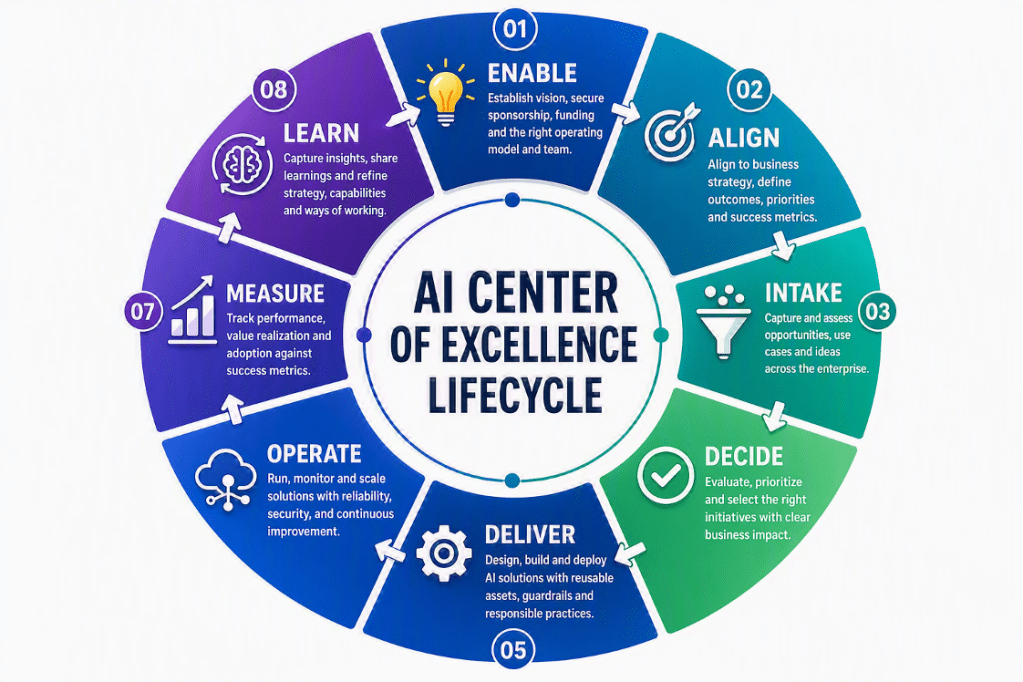
What emerged was not organized around headcount or hierarchy. It was organized around the lifecycle pictured below:
Stephen Kaufman
This lifecycle framing is deliberate. An AI CoE that focuses only on “Deliver” without investing in “Enable,” “Measure,” and “Learn” will plateau quickly. The full lifecycle ensures the CoE creates compounding organizational capability over time, not just a project pipeline.
Each pillar in the lifecycle describes where the CoE will consistently drive outcomes: recurring improvement areas observed across discovery sessions, readiness assessments and production deployments.
The starting “Enable” pillar sets out to provide enterprise-wide enablement for AI, explicitly not owned by any individual business unit. This independence is essential for credibility. A CoE housed within one business unit will always be perceived, correctly, as serving that unit’s interests first. Centralized ownership reduces friction between business and technical teams and ensures risk and governance considerations are addressed early, not retroactively
The Enablement Pillar needs to consistently drive:
- Skilling. Structured learning roadmaps that guide progress from foundational to advanced levels (including certifications, progress tracking and practical project applications), made available and easy for staff to consume.
- Communities of practice. Cross-functional forums that surface patterns, reusable assets and lessons learned across business units, so expertise does not remain concentrated in pockets.
The “Intake” pillar ensures all AI use cases are well-defined, comparable and strategically aligned before any technology decision is made. In practice, business unit leads present use cases in a structured format, discuss ROI and business goals, review budget parameters and receive a prioritization decision from a cross-functional group. The intake process is the CoE’s most visible mechanism for demonstrating value. It is where the organization first experiences the CoE as a partner, not a bureaucracy. Within this pillar, the CoE consistently drives:
- Use case qualification: Application of frameworks such as design thinking and the BXT framework (Business; eXperience; Technology) to design journey maps and personas for qualification, prioritization and business alignment, with example scenarios that help teams identify workflow stages where agents can add value.
- Realistic estimates of outcomes: An up-front assessment of how realistic the goals of each AI project are before code is deployed, rather than discovering after the fact that the goals were unrealistic. This requires a clear approach to measure performance, adoption and impact.
As you move along through to “Delivery”, there needs to be a technology strategy that determines the right approach: build, buy or extend. It owns solution architecture decisions, ensures foundational infrastructure (data access, identity, dev/test environments) is in place, and applies the three-lane platform model to route work to the appropriate development capability. This pillar also carries responsibility for democratizing AI development, enabling broad adoption through governed citizen development while maintaining the guardrails that keep the organization compliant and secure. Within this pillar, the CoE consistently drives:
- Data foundation. In collaboration with a data practice team, building a unified, durable data culture and grounding strategy to fuel every agent with high-quality enterprise context.
- Well-architected AI workloads. Incorporation of Well-Architected Framework (WAF) and Cloud Adoption Framework (CAF) into the CoE’s advice frameworks, with periodic assessments of deployed architectures as both architectures and workloads evolve.
- GenAIOps processes. Appropriate GenAIOps processes implemented throughout each AI workload’s lifecycle.
- Deployment discipline. Automated deployment pipelines with versioning and the ability to rapidly roll back if a new release’s results or performance do not meet expectations.
- Monitoring and optimization. Organizational best practices around what workload elements to monitor, how monitoring is performed and how telemetry data is collected, stored and reviewed, so that significant time is not lost trying to reconstruct what caused an issue.
- Infrastructure. Where appropriate, direct management of infrastructure components: network design, VM operating system and SKU configuration, container repositories and base images and subscription configuration.
Moving from “Delivery” to “Operate”, Evaluation and LLMOps Are Non-Negotiable. One of the most common mistakes organizations make is assuming that traditional software quality assurance practices can be directly applied to AI systems. They cannot. Conventional applications are deterministic; given the same input, they produce the same output every time. Large language models, by contrast, are probabilistic systems whose behavior can vary based on model updates, prompt changes, retrieval context, grounding data and evolving user interactions. As a result, enterprise AI requires an entirely different operational discipline. A mature AI Center of Excellence must establish evaluation frameworks, golden datasets, red-team testing, drift monitoring, A/B testing, acceptance thresholds, observability capabilities, feedback loops and end-to-end traceability through correlation identifiers. These capabilities transform AI deployment from an experimental exercise into an engineered, measurable and governable business capability.
The organizations that successfully scale AI recognize that deployment is not the finish line; it is the beginning of a continuous optimization cycle. They treat AI systems as living platforms rather than static applications. Model behavior is continuously monitored, prompt performance is versioned and measured over time, outputs are continuously tested against expected outcomes, and drift detection mechanisms automatically identify degradation in quality, accuracy or relevance. Equally important, they establish rollback procedures that allow teams to quickly revert prompts, agents, retrieval pipelines or models when issues arise. This operational rigor enables enterprises to innovate aggressively while maintaining the reliability and trust required for business-critical workloads.
What is emerging today with AgentOps, LLMOps and AI observability engineering is remarkably similar to what occurred with DevOps more than a decade ago. Organizations eventually learned that software delivery could not scale through manual processes, disconnected tools and siloed teams. The same reality now applies to AI. As enterprises move from isolated proofs of concept to fleets of agents, copilots and intelligent applications, they require automated processes for monitoring, evaluation, governance, deployment and lifecycle management. LLMOps is rapidly becoming the operational foundation that enables AI systems to scale safely, reliably and efficiently across the enterprise.
For CIOs, the implication is clear: responsible AI is impossible without operational visibility. If an organization cannot explain why a particular AI response was generated, identify which model produced it, determine what grounding data influenced the outcome, or detect when quality has deteriorated over time, then it is not operating enterprise AI at scale with the level of discipline required. Trustworthy AI is not simply a function of model selection. It is the result of rigorous evaluation, comprehensive observability and continuous operational governance embedded throughout the AI lifecycle. In the age of enterprise AI, LLMOps is no longer optional infrastructure; it is a core competency.
The last pillar I am going to cover in depth is “Measure”. Setting KPIs and measuring against them is pivotal to gauging effectiveness. Regular assessment allows the CoE to track progress, identify trends and foster a culture of continual improvement. Collecting the data is not enough. It must be visible (both good and bad), so that issues, changes required and decisions are based on evidence rather than anecdotes.
High-maturity customers do not track AI accuracy alone. They consistently measure across five dimensions:
| Dimension | What’s Measured |
| Productivity | Time saved, cycle-time reduction, hours returned to employees. |
| Operations | Cost, downtime, automation rate, throughput. |
| Quality | Accuracy, forecast reliability, first-time-right rate. |
| People | Adoption, burnout reduction, satisfaction, capabilities. |
| Trust | Governance posture, human-override rate, policy adherence. |
However, sitting across all the pillars, AI risk and governance is engaged throughout the lifecycle, not as a gate at the end, but as a continuous participant. This positions the CoE as a responsible innovator, not a shadow-IT function that moves fast and asks forgiveness later. Within this pillar, the CoE consistently drives:
- Security controls and guardrails. Guidelines and compliance support that work with existing security and workload teams so that security considerations are embedded into every AI-related process and aligned with organizational security policies.
- Compliance. Mechanisms to assess whether workloads are compliant against relevant standards. It remains the responsibility of AI workload teams to configure their workloads to meet regulatory requirements.
- Cost management (FinOps). Processes and tools to monitor, forecast and optimize spending, ensuring that models and resources are efficiently utilized. FinOps principles drive collaboration between finance, engineering and business teams so that financial considerations are integrated into every stage of AI solution development and deployment.
Emerging trends shaping AI CoEs in 2026 and beyond
As AI adoption accelerates, the mandate of the AI Center of Excellence is expanding well beyond model selection and governance. The next generation of AI CoEs will be responsible for addressing emerging challenges such as agentic AI governance, multi-agent orchestration standards, AI cost governance and token economics, memory and context management, and the oversight of increasingly diverse open-source and proprietary model ecosystems. At the same time, enterprise model marketplaces are emerging as a mechanism for standardizing the discovery, approval, deployment and lifecycle management of AI assets across the organization. Together, these trends signal a fundamental shift: the AI CoE of the future will operate not only as a governance body, but as the enterprise institution responsible for managing the full operational, economic, security and regulatory lifecycle of AI at scale.
Conclusion
The organizations achieving the greatest success with enterprise AI are not necessarily those with the largest or latest models or innovation budgets. They are the organizations that established governance, evaluation, observability, security and organizational readiness early in their AI transformation journey. These foundational capabilities enabled them to move beyond experimentation and scale AI responsibly across the enterprise.
As AI adoption accelerates, the AI Center of Excellence is evolving from a strategic advisory group into a mission-critical operational function. Modern AI CoEs are increasingly responsible for standardization, risk management, security enforcement, lifecycle governance and operational scalability across AI platforms and agents.
Ultimately, the next generation of AI leaders will not be measured by how many Proofs-of-Concept or AI pilots they launched, but by how securely, responsibly and repeatably they operationalized AI to deliver measurable business value at enterprise scale.