Every technology professional working today owes their career, in part, to someone who took a chance on them. The software engineers, cybersecurity analysts and infrastructure specialists on our teams didn’t arrive fully formed and ready to perform. Someone hired them, trained them and gave them room to grow. That’s worth remembering now, because the tech talent pipeline is shrinking, and history shows it can take more than a decade to recover from a decline like this.
The pipeline is at risk on two fronts: fewer students are choosing to study computer and information science, and hiring managers anticipate weaker near-term demand for these graduates. This isn’t unprecedented. The computing profession has weathered two major talent declines in its short history, and each took more than a decade to recover.
After 15 years of growth, computing enrollment reverses
According to the U.S. National Center for Education Statistics, the number of computer science and information science B.S. graduates has grown steadily since 2010. A tech degree once meant a well-paying job and a career with a future, driven largely by increased demand for technology. That momentum now appears to be reversing across several regions of the world.
Research from the National Student Clearinghouse Research Center indicates that enrollment in CS and IS degree programs at U.S. colleges and universities fell by more than 8% in 2025, even as overall undergraduate enrollment grew by 1%. The trend is not confined to the U.S. According to BCS, the Chartered Institute for IT, the UK saw a similar decline, with 18-year-old UK students entering computing degree programs down 9% in 2025. In Australia, the decline appears even steeper. ACS/Information Age reports that the Australasian Conference of Tertiary Admissions Centres’ (ACTAC) January 2026 report shows a 21% decline in enrollment for IT-related degrees heading into 2026.
Three countries, three distinct education systems, one common outcome. What makes this notable isn’t any single data point but the swift, dramatic downturn across all three countries. If this were confined to one market, it could be dismissed as a local correction; however, a similar pattern across the United States, the United Kingdom and Australia at roughly the same time suggests a structural shift in how the next generation views a tech career.
What 1,200 tech leaders expect: Lower demand for graduates
If the problem were only fewer graduates, but hiring demand were strong, the situation would probably correct itself. Talent scarcity would drive up wages and attract more students. However, the demand side appears to be contracting as well.
In the second quarter of 2026, I surveyed more than 1,200 senior technology leaders across 53 countries and what they expected their organization’s hiring demand to look like five years from now for entry-level roles filled by graduates with bachelor’s degrees in computer science or information science. Respondents held titles including CIO, CTO, VP of IT and Head of IT. More than 6,600 surveys were sent to technology leaders via LinkedIn, resulting in a 19% response rate.
The results were sobering: 45% anticipated lower demand, 28% expected demand to remain the same, while 27% anticipated it to increase. (You can download a summary of the survey at https://www.impactfultechnologyleader.com).
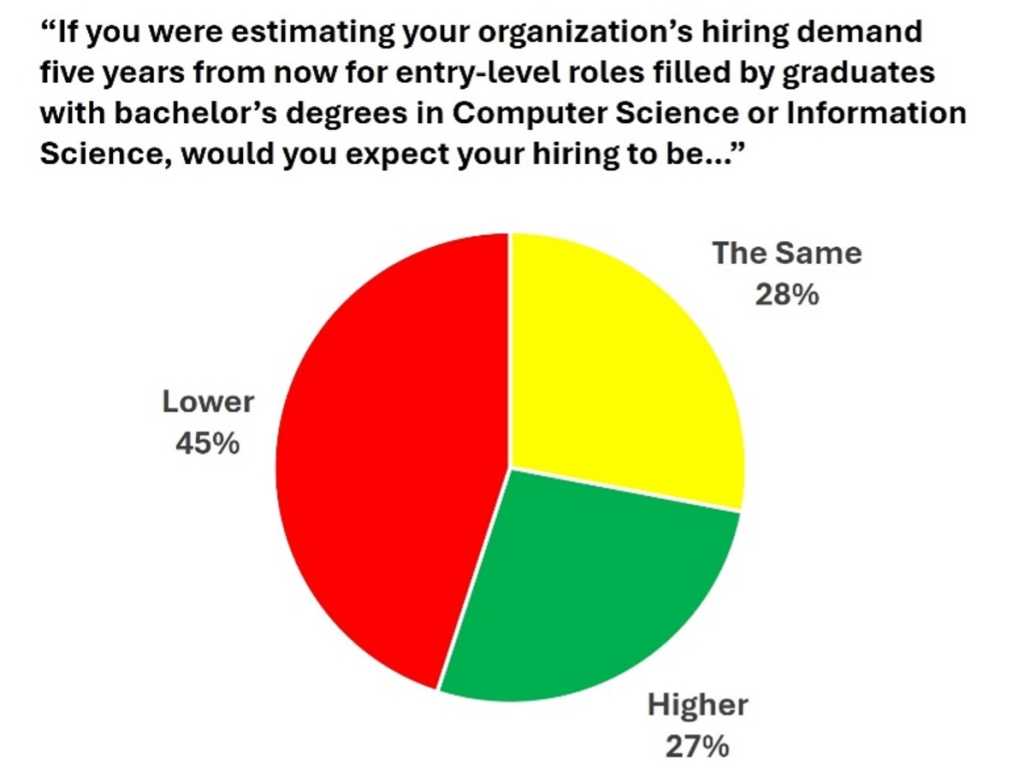
This result was not limited to a specific country or region. Those expecting hiring demand to be lower in five years were in the majority across almost every country, industry and company size.
The reason, cited across every group, was the same: artificial intelligence. Leaders expect AI to automate much of the entry-level technical work, including routine coding, service-desk tickets and administrative tasks. This is the work where new graduates have traditionally begun their careers. The logic is that existing teams, aided by AI, can do more without adding entry-level employees.
Regardless of their responses to the survey question, many of the leaders noted that reducing the number of junior roles in their organization was problematic. They recognized that it would erode the pipeline for future senior talent and that recovery from this gap would take years.
We’ve seen this movie before
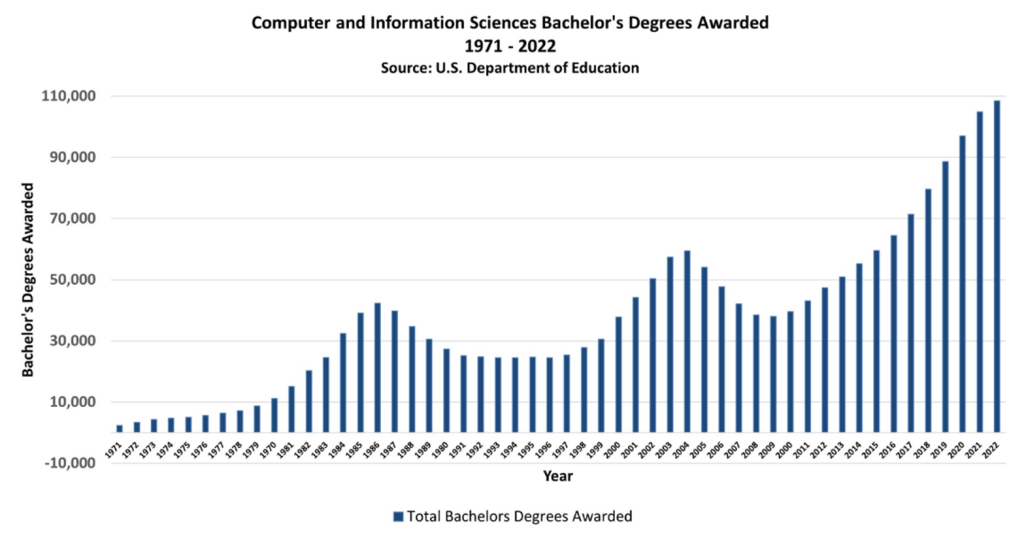
This is not the first time CS and IS graduate numbers have fallen. In the mid-1980s, universities were overwhelmed by demand for computing degrees and couldn’t staff their programs adequately. When computer science programs could no longer accommodate surging student interest, universities capped enrollment and tightened admission standards. The effect was dramatic: bachelor’s degrees in computer and information sciences fell sharply beginning in 1987. It was not until 2001, fifteen years later, that graduation rates recovered to their earlier level.
The second decline came in the early 2000s, in what might be called a perfect storm. The winding down of Y2K remediation, the bursting of the dot-com bubble and a rising wave of IT offshoring converged to shake confidence in technology as a career. Mass layoffs swept through IT departments and dot-com firms, and enrollment in computing programs fell once again. The resulting drop in tech degrees awarded began around 2005, and it was not until 2016, eleven years later, that graduation rates recovered to the same level.
The chart below from the U.S. National Center for Education Statistics depicts these two significant declines in graduates with technology degrees.
Is AI the new perfect storm?
If you map today’s forces onto that history, the parallels are hard to miss. AI-driven automation is creating a demand shock, declining technology enrollments are creating a supply shock, and growing skepticism about the value of a technology degree is creating a confidence shock. This mirrors the erosion of faith in the career path after the dot-com bubble burst.
What took three separate crises to unfold in the early 2000s is converging today into a single, self-reinforcing cycle: fewer students entering the field, fewer opportunities perceived to be waiting for them, and growing doubts about whether a technology career is still worth pursuing.
But the parallel to those earlier declines carries a warning, not a reassurance, and the difference is in how each one ended. The recoveries of 2001 and 2016 happened because demand never left. In both prior declines, the supply of graduates fell while the underlying need for tech professionals rebounded. That gap between shrinking supply and steady demand is exactly what refilled the pipeline: scarcity pushed up wages, wages pulled students back and the market corrected itself, however slowly. What makes today different is that supply and demand are falling together. If leaders are correct that AI will replace entry-level work, this is not a demand dip waiting to rebound, it is a demand replacement, with no scarcity signal to trigger the correction that saved the field twice before.
The most dangerous feature of a talent pipeline is its lag. The decisions made, or not made, over the next few years will not trigger a crisis next quarter or even next year. Their consequences will surface a decade or more from now, when today’s would-be entry-level personnel should have become tomorrow’s architects, technical experts and leaders.
By then, the shortage will already be baked into the pipeline. And that is not speculation. It is the exact pattern the historical record has already shown us, twice.
What is a technology leader to do?
It would be easy to read my survey results and conclude that the market will sort itself out. Nearly half of the IT leaders I surveyed plan to hire fewer entry-level computing graduates over the next five years. Many dismiss this: education will adapt, five years is an eternity and better tools will make new graduates more capable than ever. They may be right. But hope is not a workforce strategy, and the leaders best positioned five years from now will be those who treat this as a problem to solve, not a trend to watch.
The uncomfortable truth is in one respondent’s warning: “We will have to find a way to invest in new grads, or we will not have a pipeline of middle and senior talent later.” If every organization cuts entry-level hiring because AI now handles the routine work, our profession will slowly stop developing the senior engineers it will desperately need a decade from now, because senior people are simply junior people who were given room to grow. No single leader can solve this problem, but every leader can refuse to be the one who lets it happen to their organization.
That starts with treating early-career hiring as a strategic investment, not the first line item to cut. Set aside several junior roles intentionally as an investment in your future leadership, rather than as just headcount to cut in the upcoming budget cycle.
It also means redefining what “entry-level” even means. Survey respondents were consistent: the bar is changing. They want applicants with a strong portfolio over a strong transcript, demonstrable AI fluency over rote coding, and, in the words of one, “people who can ask the right questions” now that AI supplies the answers. Rewrite your junior roles and interviews around critical thinking and judgment, and recognize that a new graduate’s value now lies in growth potential and the ability to direct AI-assisted work, not raw output.
Finally, the talent pipeline begins with encouraging high school students to seriously consider a career in technology, and guiding them will take all of us. If history holds, many will steer away from computing if they believe it has no future. Before committing to an investment as large as four years of tuition, parents will point their children toward fields with steady or rising demand.
Technology leaders and their teams can cut through the hype and help students understand what a career in technology looks like in the age of AI. Through classroom talks and on-site job shadowing, they can give students a real chance to discover the opportunities computing offers. Through mentoring and hands-on, real-world projects, they can support STEM programs at both the primary and secondary education levels.
With the aid of other technology professionals and leaders, I have developed a directory of organizations that promote and support careers in computing across the globe. The directory, which can be found at impactfultechnologyleader.com, includes:
- Programs for grade school, high school and university students
- Support for working professionals, whether already in tech or breaking into it
- Groups serving those transitioning from the military, returning to work or navigating any other path
Every one of us in this profession got here because someone decided we were worth the investment before we had proven it. That decision was never really about what a junior professional could contribute on day one. It was a bet on who they could become. AI may change what that first job looks like, but it doesn’t change a fundamental truth: to become a senior technology professional, you first had to be a junior one. The leaders who understand that over the next five years won’t necessarily be the ones who predicted AI correctly. They’ll be the ones who understood that some risks are worth hedging against even when you can’t be certain, and that a talent pipeline, once broken, takes a decade or more to rebuild.
The question isn’t whether the pipeline is at risk; it’s what you will do to make sure it doesn’t break.